Table of Contents
Cholinergic Drugs
Cholinergic drugs (or Parasympathomimetic drugs) produce actions similar to Acetylcholine or parasympathetic stimulation, and can be further subdivided into direct or indirect acting. Direct acting cholinergic drugs are agonists of cholinergic receptors, whereas, indirect acting drugs inhibit cholinesterase enzyme and reduce metabolism of Acetylcholine, thus increase Acetylcholine and the cholinergic activity.
Muscarinic Actions
A. Direct Acting:
Pilocarpine (natural alkaloid and a tertiary amine)
Bethanechol and Carbachol (synthetic drugs and quaternary amines)
Note: The tertiary amine are more lipid soluble and easily cross the blood brain barrier (BBB), while the quaternary amines are less lipid soluble and poor to cross BBB.
Mechanism of action: These drugs are direct agonists of muscarinic or nicotinic receptors or both at the target sites and produce their particular effects like contraction of smooth muscle, e.g in GI, respiratory tract and urinary bladder; and an increase of exocrine gland secretions, e.g. salivation and sweating.
B. Indirect Acting:
These are of two types: reversible or irreversible.
a. Reversible: Binding to cholinesterase enzyme is weak (hydrogen bonds) and their actions are easily reversible.
Edrophonium (very short acting, duration of action is around 15 minutes)
Physostigmine, Neostigmine (intermediate acting, duration of action 3-5 hours)
Distigmine (longer acting, duration of action 6-8 hours)
Note: Physostigmine is a natural alkaloid, tertiary amine, more lipid-soluble and can cross blood brain barrier (BBB). Others are synthetic, quaternary amines, less lipid-soluble and poor to cross BBB.
b. Irreversible: Binding to cholinesterase enzyme is strong (covalent bonds) and their actions are not easily reversible. Only few of them are clinically useful and most of them are used as insecticides or war gases. Chemically these are mostly organophosphorous compounds.
Clinically useful: Ecothiophate and Isofluorophate
Insecticides: Alathion and Parathione
War gases: Soman and Tabun
Mechanism: Act indirectly by inhibiting cholinesterase enzyme that metabolizes acetylcholine, thus increase its concentration at the target sites and produce muscarinic and nicotinic actions.
Pharmacological Actions
The pharmacological actions of direct and indirect acting cholinergic drugs are similar and are described together.
A. Muscarinic Actions
a. GI:
They increase the secretion of salivary glands via activation of the muscarinic (M3) receptors. Therefore, Pilocarpine is used in the treatment of dryness of mouth that occurs after radiation therapy for jaw and oral cancer or in Sjogren syndrome (Symptom complex of dry mouth, dry eye, associated with rheumatoid arthritis).
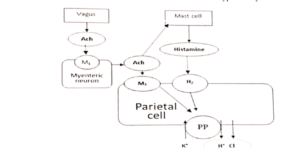
HCl secretion in stomach is increased via activation of M1 receptors on the myenteric neurons and M3 receptors on the parietal cells (Figure 2.2.1).
The exocrine glands and the smooth muscle of GI tract also ha
ve M3 receptors. Their activation increases GI secretion and the peristalsis, while sphincters are relaxed.
These effects permit the use of these drugs in paralytic ileus, e.g. after anaesthesia or abdominal surgery. Toxic doses can cause diarrhoea, intestinal colic and hyperacidity.
(Image Description: A diagram showing the pathway of Vagus nerve stimulation leading to Ach release, acting on M1 receptors of Myenteric neurons, then M3 receptors on Parietal cells and Mast cells. Mast cells release Histamine to H2 receptors, ultimately triggering the Proton Pump (PP) to exchange K+ for H+.)
Figure 2.2.1. Vagal stimuli, initially in response to smell and taste of food and later presence of food in the stomach, activate neurons of myenteric plexus via M1 receptors. Acetylcholine (Ach) released from these neurons activates M3 receptors on the parietal cells, which in turn trigger ‘Proton pump’ (PP) on the luminal side of the parietal cell to produce HCl. Ach also activates mast cells to release histamine which activates PP to produce HCl via histamine H2 receptors. [Note: PP actively secretes H+ in exchange to K+. The Cl− is passively shifted to the lumen of gastric gland canaliculus to make HCl. In case H+ & Cl− ions meet within the parietal cell would burn everything in the cell. The mucosa of the canaliculus is well protected by the mucin and bicarbonate produced by nearby epithelial cells in response to prostaglandin-E (PGE). It may be mentioned here that PG synthesis inhibitors (Aspirin like drugs) reduce this protective role of PGE in the stomach and cause uncontrolled increase in HCl secretion and decrease in mucin and bicarbonate formation leading to hyperacidity, peptic ulceration and bleeding in the stomach (Chapter 4.1, side effects of NSAIDs)].
b. Eye:
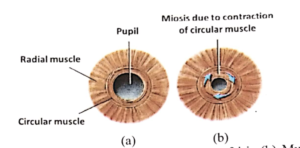
i. Miosis
Muscarinic agonists via M3 receptors contract the circular muscle of iris andthe pupil constricts (Figure 2.2.2). [Circular muscle of iris has M3 receptors & radial muscle α1 receptors].

Figure 2.2.2. (a) Normal pupil, circular and radial muscle of iris (b) Muscarinic agonists (e.g. Pilocarpine) contract circular muscle of iris and constrict the pupil.
ii. Spasm of accommodation
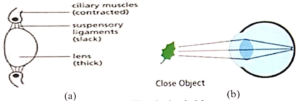
Ciliary body also have M3 receptors, which contractsand the suspensory ligaments are relaxed. The lens becomes more convex and the eye is fixed for near vision (Figure 2.2.3).
Figure 2.2.3. (a) Muscarinic agonists contract ciliary body via M3 receptors, suspensory ligaments relax, and lens becomes more convex. (b) Eye is fixed for near vision.
iii. Lower intra-ocular pressure (IOP)
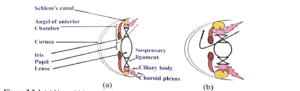
Miosis and contraction of the ciliary body causes opening of the a
ngle of anterior chamber and Schlem’s canal, which facilitate the drainage of aqueous humour and IOP is decreased (Figure 2.2.4).
Figure 2.2.4. (a) Normal iris, pupil size, angle of anterior chamber and Schlem’s canal. (b) Pilocarpine constricts pupil and ciliary body, widens angle of anterior chamber and Schlem’s canal, increases drainage of aqueous humor and lowers intraocular pressure.
c. CVS:
The heart has muscarinic (M2) receptors on SA-node, AV-node and the myocardium. Muscarinic agonists can cause sinus bradycardia, slowing of AV-conduction and an increase of atrial automaticity. The toxic doses can cause cardiac arrest, AV-block and atrial flutter and fibrillation.
d. Respiratory tract:
Bronchial smooth muscle contracts and the secretions of exocrine gland are increased via activation of muscarinic (M3) receptors. Toxic doses can cause difficulty of respiration and feeling of tightness in the chest.
e. Genito-urinary system:
Due to activation of M3 receptors the urinary bladder wall contracts, the bladder sphincter relaxes, uterus (in pregnancy) contracts and there is penile erection. Therefore, some of the muscarinic agonists (e.g. Neostigmine) can be used in atonia of urinary bladder (e.g. after anesthesia or surgery). While toxic doses of these drugs can cause urinary urgency or incontinence (voiding), abortion and priapism.
f. Skin (Sweat glands):
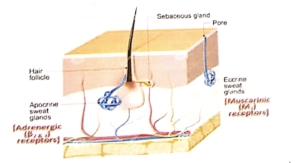
‘Eccrine sweat glands’ are present over most parts of the body and have M3 receptors. When activated by cholinomimetic drugs produce copious watery secretion. The increased sweating lowers body temperature, thus eccrine sweat glands are involved in control of body temperature (Figure 2.2.5).
[Note: The ‘Apocrine sweat glands’ are mainly found on areas of the skin with abundance of hair, like scalp, armpits, groin and some parts of the external genitalia (e.g. scrotum). They are also found in the areola and nipple of the breast, ear canal, eyelids and wings of the nostril (nose tip). Apocrine glands have beta-2 and beta-3 adrenoceptors, when activated with Adrenaline or other beta-2 agonists produce an oily and scenty secretion. Being sensitive to adrenaline, apocrine sweat glands are involved in emotional sweating induced by anxiety, stress, fear, sexual stimulation and pain].
Figure 2.2.5. Schematic diagram of skin showing ‘Eccrine sweat glands’ (right), opening directly onto skin, and ‘Apocrine sweat glands’ (left) opening into the skin via hair follicle. The eccrine glands have muscarinic (M3) receptors, whereas, apocrine glands have adrenergic (β2 & β3) receptors.
Nicotinic Actions:
C. CNS effects:
The CNS effects are due to activation of both the nicotinic and muscarinic receptors present in the CNS. Depending on the dose there may be confusion, tremors, emesis, convulsions and coma.Uses:
a. Sjogren syndrome: In therapeutic doses Pilocarpine and Cevimeline are used for the treatment of dryness of mouth in Sjogren syndrome.Adverse effects:
Exocrine glands: Increased salivation, sweating and lacrimation.Contraindications:
Asthma, peptic ulcer and angina.Oral and Dental Implications of Cholinergic Drugs:
a. Pilocarpine is used primarily to treat acute angle closure glaucoma in ophthalmology. May increase salivation, which usually not troublesome. b. Pilocarpine and Cevimeline may be used to increase salivary flow, particularly, in conditions causing persistent dryness of mouth. Because dryness of mouth increases chances of caries. Conditions causing dry mouth include Sjogren syndrome and long-term use of drugs which have anti-muscarinic side effects, like some antidepressants and antihistamines.