
The neurotransmitter of the sympathetic system is mainly Noradrenaline.
In post-ganglionic sympathetic neurons, Noradrenaline is synthesized from tyrosine. Tyrosine is actively taken up by the neurons and converted to dihydroxy-phenyl-alanine (DOPA), dopamine and nor-adrenaline. The rate limiting step in the synthesis of noradrenaline is the conversion of tyrosine to DOPA by tyrosine hydroxylase enzyme. DOPA is then converted to dopamine by DOPA-decarboxylase enzyme and dopamine to noradrenaline by dopamine beta-hydroxylase enzyme (Fig 2.1.3.a).
Noradrenaline is stored in vesicles in axonal terminals of the post-ganglionic sympathetic neurons and released in response to impulses from the CNS, which activate vesicular monoamine transporter (VMAT). Released Noradrenaline activates alpha and/or beta receptors on the target sites to produce its actions. Then, most of it (80-90%) is taken-up back by the sympathetic nerve terminals by Noradrenaline Transporter (NAT) and restored in the vesicles. The amount not stored is metabolized by Mono-Amine-Oxidase (MAO) enzyme within the neuron to dihydroxymandelic acid, which diffuses out and further metabolized in the synapse by Catechol-O-Methyl Transferase (COMT) enzyme. Small amount is taken up by the surrounding tissues.
In adrenal medulla, at first Noradrenaline is synthesized, in the same way it is synthesized in the post-ganglionic sympathetic neurons (Figure 2.1.3b, Top). Most of it is converted to adrenaline by N-methyl-transferase enzyme present in the adrenal medulla. Adrenaline (80%) and noradrenaline (20%) are released into the circulation (Figure 2.1.3b, Bottom).
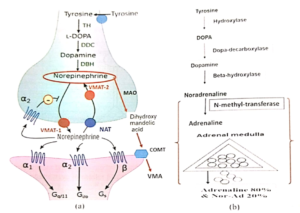
Figure 2.1.3. (a) Sympathetic neurons. Synthesis of Noradrenaline and enzymes required [TH (tyrosine hydroxylase), DDC (dopa-decarboxylase), DBH (dopamine-beta-hydroxylase)]. Released by activation of VMAT-1 (vesicular monoamin
e transporter-1). Most of released Noradrenaline is taken-up by NAT (Noradrenaline transporter) into axonal terminal and by VMAT-2 (vesicular monoamine transporter-2) into the vesicle. Amount not restored in vesicle is metabolized by MAO (Mono-Amine Oxidase) within neuron to dihydroxy-mandelic acid, which is further metabolized by COMT (Catechol-O-Methyl Transferase) in synaptic space. Released Noradrenaline acts on specific receptors ($\alpha$ &/or $\beta$) on the post-synpatic membrane. Control on excessive release of Noradrenaline is achieved via Alpha-2 receptors on presynaptic membrane (Negative feed-back).
(b) Adrenal medulla. Initially, Noradrenaline is synthesized in the adrenal medulla like in the sympathetic neurons (Top). Then, most of it (around 80%) is changed to Adrenaline by N-methyltransferase enzyme (Bottom).
Noradrenaline released from adrenergic nerve endings (not re-uptaken) and adrenaline and noradrenaline released from the adrenal medulla into circulation are metabolized in plasma and liver by Monoamine Oxidase (MAO) and Catechol-O-Methyl Transferase (COMT) enzymes. Major final product of their metabolism is Methoxy-mandelic acid or Vanillyl-Mandelic Acid (VMA) and minor intermediate metabolites are normetanephrine and metanephrine (Fiureg.2.1.4).
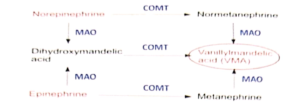
Fiureg.2.1.4. Metabolism of Norepinephrine and Epinephrine) by Monoamine Oxidase (MAO) and Catechol-O-Methyl Transferase (COMT) enzymes to Vanillyl-mandelic acid (VMA).
VMA, very small amounts of intermediate metabolites (Normetanephrine and metanephrine) and traces of un-metabolized noradrenaline and adrenaline are excreted in urine. Turnover of catecholamines in the body can be detected from the measurement of total metabolites (VMA and metanephrines) in 24-hour urine sample.