
ANATOMY
The eye is the organ of sight situated in the orbital cavity. It is almost spherical in shape and is about 2.5 cm in diameter. The volume of an eyeball is approximately 7 cc. The space between the eye and the orbital cavity is occupied by fatty tissue. The bony wall of the orbit and the fat helps to protect the eye from injury. Structurally the two eyes are separate but they function as a pair. It is possible to see with only one eye, but three-dimensional vision is impaired when only one eye is used specially in relation to the judgement of distance
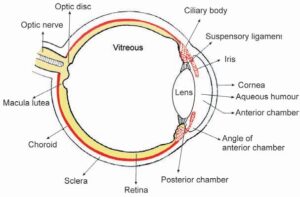
Structure of eye
Structure of the Eye
The eyeball has three layers namely:
- The outer fibrous layer—Sclera and cornea
- The middle vascular layer—Iris, ciliarybody and choroid
- The inner nervous tissue layer—
Interior of the Eyeball
The structures inside the eyeball are:
- Aqueous humour
- Lens
- Vitreous.
Accessory Structures of Eye
- Eyebrows
- Eyelids and eyelashes
- Lacrimal apparatus
- Extraocular muscles of the
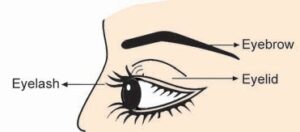
STRUCTURE OF THE EYE
1. The Outer Fibrous Layer
- Sclera—The sclera or white of the eye forms the firm, fibrous outermost layer of the eye. It maintains the shape of the eye and gives attachment to the extraocular It is about 1 mm thick. The sclera becomes thin (seive-like membrane) at the site where the optic nerve pierces it. It is called Lamina cribrosa.
- Cornea—Cornea forms the anterior 1/6 of the eye . The transparent, ellipsoid, anterior part of the eyeball is known as the cornea. It is the main refracting surface of the eye. The dioptric power is + 43 to + 45 D.
- Limbus—The junction of cornea and sclera is known asthe There is a minute arcade of blood vessels about 1 mm broad present at the limbus.
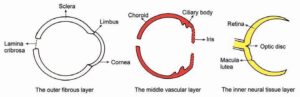
2. The Middle Vascular Layer
- Iris—Iris is a coloured, free, circular diaphragm with an aperture in the centre—the pupil. It divides the anterior segment of the eye into anterior and posterior chambers which contain aqueous humour secreted by the ciliary It consists of endothelium, stroma, pigment cells and two groups of plain muscle fibres, one circular (sphincter pupillae) and the other radiating (dilator pupillae).
- Ciliary body—Ciliary body is triangular in shape with base The iris is attached to the middle of the base. It consists of non-striated muscle fibres (ciliary muscles), stroma and secretory epithelial cells. It consists of two main parts, namely pars plicata and pars plana.
- Choroid—Choroid is a dark brown, highly vascular layer situated between the sclera and It extends from the ora serrata up to the aperture of the optic nerve in the sclera.
3. The Inner Nervous Tissue Layer
- Retina—Retina is composed of ten layers of nerve cells and nerve fibres lying on a pigmented epithelial layer. It lines about 3/4 of the eyeball. Macula lutea is a yellow area of the retina situated in posterior part with a central depression called fovea It is the most sensitive art of retina.
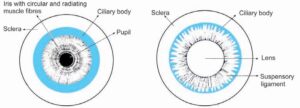
- Optic disc—Optic disc is a circular, pink coloured disc of 1.5 mm diameter. It has only nerve fibre layer so it does not excite any visual response. It is known as the blind spot.
- The optic nerve—The optic nerve extends from the lamina cribrosa up to the optic The total length of the optic nerve is 5 cm. It has four parts namely,
- Intraocular — 1 mm
- Intraorbital — 25 mm
- Intraosseous — 4-10 mm
- Intracranial — 10 mm (Duke–Elder).
INTERIOR OF THE EYEBALL
1. Aqueous Humour
Both anterior and posterior chambers contain a clear aqueous humour fluid secreted into the posterior chamber by the ciliary epithelium. It passes in front of the lens, through the pupil into the anterior chamber and returns to the venous circulation through the canal of Schlemm situated in the angle of anterior chamber.
2. Lens
Lens is a transparent, circular, biconvex structure lying immediately behind the pupil. It is suspended from the ciliary body by the suspensory ligament or zonule of Zinn. It is enclosed within a transparent capsule.
3. Vitreous
Vitreous is a transparent, colourless, inert gel which fills the posterior 4/5 of the eyeball. It contains few hyalocytes and wandering leucocytes. It consists of 99% water, some salts and mucoproteins.
ACCESSORY STRUCTURES OF THE EYE
The eye is a delicate organ which is protected by several structures such as eyebrows, eyelids, eyelashes and extraocular muscles.
1. Eyebrows
Eyebrows are two arched ridges of the supraorbital margins of the frontal bone. Numerous hair (eyebrows) project obliquely from the surface of the skin. They protect the eyeball from sweat, dust and other foreign bodies.
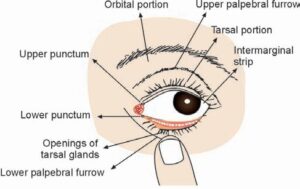
2. Eyelids and Eyelashes
The eyelids are two movable folds of tissue situated above and below the front of each eye. There are short curved hair, the eyelashes situated on their free edges.
The eyelid consists of:
- A thin covering of skin
- Three muscles—the orbicularis oculi, levator palpebrae superioris and Müller’s muscles
- A sheet of dense connective tissue, the tarsal plate
- A lining of the
3. Lacrimal Apparatus
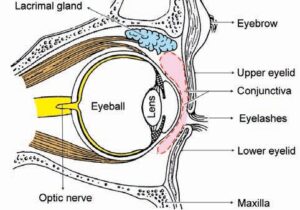
Lacrimal apparatus consists of:
- Lacrimal gland and its ducts
- Accessory lacrimal glands
- Lacrimal canaliculi
- Lacrimal sac
- Nasolacrimal duct
The tears are secreted by the lacrimal gland and accessory lacrimal glands. They drain into the conjunctival sac by small ducts. The tears then pass into the lacrimal sac (via the two canaliculi), nasolacrimal duct and finally into the nasal cavity (inferior meatus).
4. Extraocular Muscles of the Eye
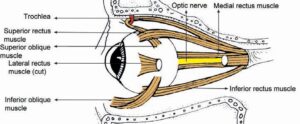
The eyeballs are moved by six extrinsic muscles, attached at one end to the eyeball and at the other to the walls of the orbital cavity. There are four straight and two oblique muscles.
They consist of striated muscle fibres. Movement of the eyes to look in a particular direction is under voluntary control but co-ordination of movement needed for convergence and accommodation to near or distant vision, is under autonomic control.
- The medial rectus rotates the eyeball inwards.
- The lateral rectus rotates the eyeball outwards.
- The superior rectus rotates the eyeball upwards.
- The inferior rectus rotates the eyeball downwards.
- The superior oblique rotates the eyeball so that the cornea turns in a downward and outward directions.
- The inferior oblique rotates the eyeball so that the cornea turns upwards and outwards.
BLOOD SUPPLY TO THE EYE
Arterial Supply
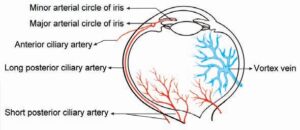
The eye is supplied by the short (about 20 in number) and long ciliary (2 in number) arteries and the central retinal artery. These are branches of the ophthalmic artery, which is one of the branch of the internal carotid artery.
Venous Drainage
Venous drainage is done by the short ciliary veins, anterior ciliary veins, 4 vortex veins and the central retinal vein. These eventually empty into the cavernous sinus.
NERVE SUPPLY TO THE EYE
The eye is supplied by three types of nerves, namely motor, sensory and autonomic.
1. The Motor Nerves
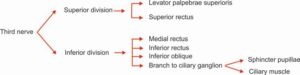
- The third cranial nerve (oculomotor)
- The 4th cranial nerve [trochlear]—It supplies the superior oblique
- The 6th cranial nerve [abducens]—It supplies the lateral rectus
- The 7th cranial nerve [facial]—It supplies the orbicularis oculi
2. The Sensory Nerve
The 5th cranial nerve [trigeminal]—The ophthalmic division supplies the whole eye.
3. The Autonomic Nerves
- The sympathetic nerve supply is through the cervical sympathetic fibres to:
- Iris—Dilator pupillae muscle
- Ciliary body
- Müller’s muscle in the lids
- Lacrimal
- The parasympathetic nerve supply originates from the nuclei in the It gives branches to:
- Iris—Sphincter pupillae muscle
- Ciliary body
- Lacrimal