
Glycosaminoglycans (GAGs):
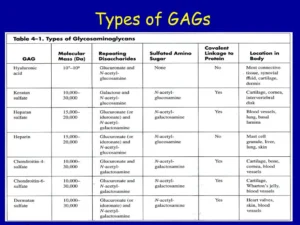
Role of Hyaluronidase: It targets hyaluronic acid, one of the GAGs involved in the barrier formation, thus allowing bacteria to penetrate tissues more easily.
- Cells of macrophage-mononuclear phagocytic system: Structure, distribution and function of these cells are tabulated below:
Cells of macrophage-mononuclear phagocytic system:
Macrophage: Large, irregular-shaped cells found throughout the body. Function in phagocytosis, antigen presentation, cytokine production, tissue repair, and immune regulation.
Monocyte: Kidney-shaped nucleus circulates in the bloodstream as precursors of macrophages.
Dendritic cells: Branched extensions (dendrites), located in lymphoid organs. Function in antigen capture, processing, and presentation to activate T cells, bridging innate and adaptive immune responses.
Langerhans cell: Granules, dendrite process, found in the skin (epidermis). Function in antigen capture in the skin and initiation of immune responses in the skin.
Kupffer cells: Satellite-shaped cells with microvilli, located in the liver sinusoid. Function in phagocytosis of pathogens and debris in the liver and regulation of immune responses in the liver.
Microglial cells: Small, highly branched cells, located in the CNS. Function in phagocytosis and regulation of neuro inflammation.
Macrophage role in innate immunity: Macrophages play an important role in the body’s first line of defense (innate immunity) by:
- Being involved in phagocytosis (engulfing and destroying foreign particles).
- Acting as antigen-presenting cells (presenting antigens for destruction).
- Recruiting cytokines (cytokines attract other immune cells).
- Playing an important role in tissue repair and remodeling.
Mast cells:
Structure: Abundant in loose supporting tissue around blood vessels, large, round or ovoid cells, central and pale staining nucleus, cytoplasm full of coarse granules. Metachromasia occurs when stained with toluidine blue dye, granules turn reddish purple.
Functions: Immune response regulation, inflammation (release histamine, cytokines, and leukotrienes), and wound healing.
Role in immediate hypersensitivity reactions: Sensitization (IgE antibodies bind to mast cells during initial exposure to an allergen), subsequent exposure (re-exposure to the allergen triggers mast cell activation), and mediator release (histamine release leads to allergic reaction symptoms).
Plasma cells:
Structure: Large, ovoid cells with basophilic cytoplasm (due to abundant rough endoplasmic reticulum), spherical and eccentric nucleus with chromatin arranged in a cartwheel or clock-face pattern, and a characteristic pale staining area near the nucleus (representing the Golgi complex).
Role in antibody formation: Antigen recognition and activation (B cells encountering an antigen become activated and differentiate into plasma cells), and antibody production (plasma cells synthesize antibodies specific to the encountered antigen).
Role in antibody formation:
Plasma cells are key players in antibody formation, a critical aspect of the adaptive immune response. Here’s a concise overview:
Antigen Recognition and Activation:
When B cells encounter an antigen, they become activated and differentiate into plasma cells.
Antibody Production:
Plasma cells specialize in synthesizing antibodies specific to the encountered antigen. These antibodies are identical to the B cell receptor that initiated the response.
Types of Adipose Tissues:
- White Adipose Tissue:
Structure: Consists of large unilocular lipid droplets, a thin layer of cytoplasm, and a single nucleus.
Histogenesis: Develops from fibroblast-like preadipocytes.
Location: Subcutaneous layer beneath the skin, around organs, and in bone marrow.
Function: Energy storage, insulation, and cushioning.
- Brown Adipose Tissue:
Structure: Composed of multiple small lipid droplets, numerous mitochondria, and a rich blood supply.
Histogenesis: Develops from myoblastic or pericyte-like precursors.
Location: Supraclavicular, cervical, and paravertebral regions, around the heart, and kidneys.
Function: Thermo genesis and heat production.
Lipid Storage & Mobilization from Adipocytes:
Adipocytes take up free fatty acids and glycerol from the bloodstream. Inside the adipocyte, these molecules are converted to triacylglycerols (TAG) through lipogenesis. The synthesized TAG is stored in adipocytes, forming fat droplets. Insulin increases the uptake of FFAs and glycerol from the bloodstream. During periods of energy demand, lipolysis is initiated to release stored lipids from adipocytes by lipases. These lipases break down triglycerides into free fatty acids and glycerol, a process increased in the presence of glucagon hormone.
Membranous Organelles: Endoplasmic reticulum, Golgi apparatus, Mitochondria, Lysosomes, Peroxisomes. Non-membranous Organelles: Ribosome, Cytoskeleton, Nucleolus, Nucleus, Cilia, Flagella, Chromosomes.