
EPITHELIUM:
- Basement Membrane (Structure & Function):
The interface between epithelium and the underlying connective tissue is characterized by the presence of a thin layer of a-cellular material called the basement membrane, which is further composed of 2 layers:
- Basal lamina
- Reticular lamina
- Epithelium
Basal lamina:
Lies directly beneath the basal surface of the epithelial cells.
Lamina Lucida: composed of laminin and entactin, 40nm thick.
Lamina densa: contains collagen type IV fibrils, laminin, and perlecan.
Reticular lamina:
Contains reticular fibers and a variety of glycoaminoglycans. The reticular lamina also contains fibrils of collagen type VII.
Function of basement membrane:
- Binds the epithelial cells to the underlying or surrounding connective tissue.
- Serves as a molecular sieve or ultra filter (blocks passage of macromolecules).
- Serves as scaffolding during epithelial regeneration or wound healing.
- Plays a role in cell growth, proliferation, and differentiation.
- There are two locations in the body where a single basement membrane is found between two adjacent epithelial layers:
- Alveoli of the lungs
- Glomeruli of the kidneys
Basal surface modification of epithelium (Basal Domain):
The basal surface of epithelial cells is characterized by the presence of:
Basement membrane: Also called basal lamina, a thin layer of extracellular material between the epithelial cells and the underlying connective tissue.
Hemidesmosomes: Junctions that anchor the epithelial cells to the basal lamina.
Infoldings of plasma lemma: Special feature of epithelial cells involved in active transport of ions and molecules, increasing surface area through vertical infoldings.
Intercellular junctions (Lateral surface modification) (Lateral Domain):
Epithelial tissues are characterized by close packing of cells; hence, the lateral domain of each epithelial cell lies in close contact with the lateral domain of neighboring cells.
Two main functions of the lateral domain are:
- Cell adhesion
- Cell-to-cell communication
The function of cell adhesion depends on three factors:
- Presence of cadherins (adhesive glycoprotein) in the lateral plasma membranes of adjacent cells.
- Presence of invaginations and evaginations in the lateral plasma membranes, causing cells to interdigitate and interlock.
- Presence of adhering and occluding junctions between adjacent cells.
- The function of cell-to-cell communication is served by nexuses (gap junctions).
Apical Cell Surface Specializations:
Microvilli: Tiny, finger-like projections that increase surface area for absorption, located in intestines and kidney tubules.
Cilia: Hair-like structures that move substances along the surface, found in the respiratory tract, nasal cavity, and fallopian tubes.
Stereo cilia: Long, non-motile microvilli with sensory functions, absorption, and secretion, located in the male reproductive system (epididymis).
Mechanism of Ciliary Movements:
Cilia contain a core complex of microtubules called the axoneme, arranged in a 9+1 pattern. Nine doublet microtubules surround a central pair of single microtubules. Adjacent doublets are linked by nexin bridges, and dynein arms on the outer surface of the A microtubule form temporary cross-bridges with the B microtubule, causing the doublets to slide and produce ciliary movement.
CLASSIFICATION OF EPITHELIUM
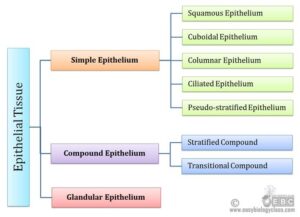
Epithelium is classified into simple, stratified, pseudo stratified, and transitional types.
Simple Epithelium:
Squamous: Flat cells found as endothelium (heart chambers, blood vessels, lymphatic vessels) and mesothelium (pleura, pericardium, peritoneum, alveoli).
Cuboidal: Dome-shaped cells in follicular cells of the thyroid gland and distal convoluted tubule of the kidney.
Columnar: Pillar-shaped cells, ciliated (stomach and uterus) or non-ciliated (intestine and gall bladder).
Stratified Epithelium:
Squamous: May be keratinized (skin) or non-keratinized (larynx, oral cavity, vagina, esophagus).
Cuboidal: Found in sweat, mammary, and salivary glands.
Columnar: Found in the male urethra and conjunctiva.
Pseudo stratified Epithelium:
Single-layer cells appear multilayered; ciliated (trachea, nose, bronchioles, nasopharynx) or non-ciliated (epididymis and vas deferens).
Transitional Epithelium:
Interconvertible between contracted (stratified cuboidal) and stretched (stratified squamous) states, found in the ureters, urinary bladder, and renal pelvis, allowing for expansion and contraction.
Lymph nodes:
Thymus (Light microscopic structure):
It is a bilobed organ devoid of lymphoid follicle and afferent lymphatic vessels.
Capsule: It is surrounded by a fibrous capsule that provides support & protection.
Cortex: The outer region of the thymus is known as the cortex. It contains numerous tightly packed lymphocytes, known as thymocytes which are undergoing development and maturation. The cortex appears as a densely stained area (deeply basophilic).
Medulla: The inner region of the thymus is called the medulla. It is less densely packed than the cortex and contains more mature thymocytes. The medulla is characterized by a lighter staining compared to the cortex (eosinophilic).
Hassall’s corpuscles: These are found within the medulla of the thymus. They appear as concentrically arranged clusters of flattened, keratinized epithelial cells. The exact function is not fully understood, but they are believed to be involved in the maturation of thymocytes.
Blood vessels: Numerous blood vessels, including capillaries, venules, and arterioles, traverse the thymus. These vessels supply oxygen and nutrients to the developing thymocytes and help remove waste products.
Spleen (Light microscopic structure):
- Largest lymphoid organ in the body
- No afferent lymphatics
- Simple squamous epithelium (peritoneum) covers the capsule of spleen.
- Capsule is composed of dense irregular connective tissue, from which trabeculae extend into the parenchyma.
- Parenchyma is supported by reticular connective tissue.
- Parenchyma of spleen (splenic pulp) is divided into red & white pulps
White Pulp: It is composed of lymphoid tissue and is involved in immune responses. It appears as discrete, rounded structures scattered throughout the spleen. The white pulp is primarily composed of:
Per arteriolar Lymphoid Sheaths (PALS): PALS surround central arteries that enter spleen. They consist of T lymphocytes & form a sheath-like structure.
Splenic Nodules (or lymphoid follicles): These are B-cell-rich areas with germinal centers, where B lymphocyte proliferate.
Red Pulp:
It is the larger region of the spleen and is involved in the filtration & storage of red blood cells.
Splenic Sinuses: These are venous channels lined by specialized endothelial cells called sinusoidal endothelial cells. The sinuses are filled with blood and allow the blood cells to come into contact with surrounding splenic tissue.
Splenic Cords (or cords of Billroth): The cords are reticular tissue strands that support the sinuses. They contain a mixture of different cell types, including RBCs, macrophages, plasma cells, and other immune cells.
Marginal Zone: This is a transitional zone located between the white pulp and red pulp. It contains a mixture of lymphoid and myeloid cells.
Histological Features of Lymph Nodes, Spleen & Thymus
Tonsils (Light microscopic structure):
- These are the aggregate of lymphoid tissues located in the upper section of the digestive tract.
- They don’t have afferent lymphatics.
Outer Capsule: The tonsils are surrounded by a connective tissue capsule.
Crypts: The surface of the tonsils is irregular and contains invaginations called crypts. These crypts increase the surface area of the tonsils, allowing for a larger area for immune cells to interact with pathogens.
Epithelium: Tonsils are covered by stratified squamous epithelium.
Lymphoid Follicles: Within the tonsils, there are numerous lymphoid follicles, also known as germinal centers. These follicles are composed of densely packed lymphocytes (B and T cells) and produce immune cells.
Palatine tonsils (Tonsils):
- Paired, ovoid in shape located in the oropharynx between anterior & posterior faucial pillars.
- The free surface is covered by stratified squamous epithelium.
- Deep invaginations, called tonsillar crypts, lined by stratified squamous epithelium dip into the substance of the tonsil from the surface.
- Surrounding each crypt lymphoid tissue is present containing numerous lymphoid follicles.
- The base of the tonsil is separated from the underlying muscle by a hemi-capsule.
Lingual Tonsils:
- Located on the dorsum of the posterior third of the tongue.
- Covered by stratified squamous epithelium.
- Each tonsil has a single crypt, which often receives openings of mucus glands.
- Lymphoid follicles are present surrounding each crypt.
- Appendix (Light microscopic structure):
Layers:
- Mucosa:
- Epithelium: Simple columnar with goblet cells
Lamina propria: Connective tissue, aggregation of lymphocytes (lymphatic nodule)
- Muscularis mucosa: Thin layer of smooth muscle
- Sub mucosa: Contains connective tissue, lymphatic tissues, blood vessels, and Meissner’s plexus
- Muscularis externa: Two layers separated by myenteric plexus; the inner layer is circular, while the outer layer is longitudinal. It lacks tenia coli.
- Serosa: Present because the appendix is completely in the peritoneum.
- Adventitia: Outermost covering of the appendix.
Histological Features of Lymph Nodes, Spleen &Thymus:
- Cortex appears as: Densely stained
- Medulla appears as: Lighter stained
- White pulp is involved in: Immune responses
- Red pulp is involved in: Filtration and storage of red blood cells
- Transitional zone located between white pulp and red pulp: Marginal zone
- Tonsils are covered by epithelium of type: Stratified squamous
- Mucosa layer of appendix consists of which type of epithelium: Simple columnar
A patient has an autoimmune disease. It may be due to defects in lymphocytes produced in: Thymus gland
Regional enlargement of lymph nodes may be due to: Inflammation of area drained by these lymph nodes
Blood thymus barrier is achieved by the following: Perivascular space containing capillaries
Components of hematopoietic & lymphoid tissues:
Bone marrow: Produces and stores hematopoietic stem cells (HSCs) and supports blood formation.
Thymus: Produces and matures T-lymphocytes for immune response.
Spleen: Filters and cleans the blood, removes old or damaged RBCs.
Lymph nodes: Filter & trap foreign particles, produce & activate immune cells.
Tonsils: Capture & destroy pathogens entering through the mouth.
Adenoids: Help fight off infections in the upper respiratory system.
Appendix: May have a role in immune function, but it is still unclear.
Lymph vessels: Transport lymph fluid and immune cells throughout the body.
Peyer’s Patches: Protect the intestines from harmful microorganisms, part of the gut-associated lymphoid tissue (GALT).
Spleen:
The spleen is reddish and is the largest single mass of lymphoid tissue in the body. It is not a component of the GI tract, despite their close relationship. It is oval-shaped and has a notched anterior border.
Spleen is not a vital organ and is mostly damaged in road traffic accidents.
Location:
It lies in the left upper quadrant of the abdomen (Hypochondriac region).
It lies under the 9th, 10th, & 11th ribs.
Relations:
Anteriorly:
The stomach, tail of the pancreas, and left colic flexure. The left kidney lies along its medial border.
Posteriorly:
The diaphragm, left pleura (left costodiaphragmatic recess), left lung, and 9th, 10th, and 11th ribs.
Coverings:
Capsule: Tough & fibrous, made of CT, helps maintain the shape.
Peritoneum: Covers the outer surface of the spleen, anchors the spleen in place.
Trabeculae: Thin, fibrous strands within the spleen, provide support.
Borders:
Superior: Sharp & notched, separate diaphragmatic & gastric surface.
Inferior: Rounded, separate gastric & diaphragmatic surface.
Anterior: Sharp & notched, separate diaphragmatic & colic surface.
Ends;
Anterior end: Sharp & notched, separate diaphragmatic & colic surface.
Medial/Posterior end: Rounded, 4cm away from midline.
Lateral/Anterior end: Present in left mid-axillary line.
Surfaces;
Diaphragmatic: It is convex & smooth.
Visceral: Anteriorly it has gastric ridge, posteriorly it has renal ridge lower extremity it has colic as pancreatic surface.
Hilum: Splenic artery (anteriorly) as splenic vein (posteriorly) enters/leaves spleen.
Splenic artery:
It is the branch of the celiac artery, which is a branch of the Aorta. (Largest branch of the celiac artery)
It has a tortuous course. It moves posterior to the omental bursa, anterior to the left kidney along the superior border of the pancreas. Then it divides into 6 branches that enter the hilum of the spleen.
Very few anastomoses are present, so the spleen has 2 separate segments (84%) or 3 segments with avascular zones that facilitate splenectomy.
Venous drainage of the spleen:
Venous drainage of the spleen occurs via the splenic vein, which also receives blood from the inferior mesenteric vein. Posterior to the neck of the pancreas, the splenic vein unites with the superior mesenteric vein to form the HPV.
Portal vein:
It collects blood from the alimentary tract, pancreas, spleen, gall bladder, etc. It runs a course of 7-8 cm. It collects blood that is reduced in oxygen but high in nutrition.
Formation:
Formed by the union of the superior mesenteric vein and splenic vein anterior to the inferior vena cava and posterior to the neck of the pancreas at the T11 Vertebra.
Tributaries: The portal vein is formed by the union of the superior mesenteric vein with the splenic vein behind the neck of the pancreas at the L1 vertebra. The main tributaries and their areas of drainage are as follows:
Superior mesenteric vein: Small intestine, large intestine (except rectum), stomach.
Splenic vein: Spleen, pancreas.
Inferior mesenteric vein: Rectum, sigmoid colon.
Left gastric vein: Lesser curvature of the stomach.
Right gastric vein: Lesser curvature of the stomach.
Para umbilical vein: Umbilical region.
Cystic vein: Gallbladder.
Superior pancreaticoduodenal vein: Superior portion of the pancreas and duodenum, bile duct.