
CELL HISTOLOGY
It is also called plasma membrane or plasmalemma, envelops the cell completely and acts as a selective structural barrier.
Electron microscopic structure:
- Average thickness of 7.5 nm.
- Trilaminar (3-layered) structure consisting of two electron dense lines separated by an electron-lucent central zone.
- Each layer is roughly 2.5 nm in thickness.
Fluid Mosaic model:
Plasma membrane is composed of phospholipids, proteins and cholesterol. It has a bimolecular layer of phospholipids (called lipid bilayer) in which are embedded proteins and cholesterol. Because the lipid bilayer is fluid in nature and the large protein molecules suspended in it exhibit a mosaic pattern, this model is known as the fluid mosaic model. Each phospholipids molecule of the lipid bilayer of the cell membrane consists of a polar (hydrophilic) head and a nonpolar (hydrophobic) tail. The head of each phospholipids molecule is composed of glycerol conjugated to a nitrogenous compound by a phosphate bridge. The nitrogenous compound may be choline, serine or ethanolamine. The nonpolar tail of each phospholipids molecule is made up of two long chains of fatty acids which are covalently linked to the glycerol component of the head of phospholipids molecule. The cholesterol molecules lie between the long fatty acid chains of the phospholipids. Cholesterol stiffens the cell membrane and, therefore, the membrane fluidity is diminished by high cholesterol content.
Glycocalyx:
The glycol-proteins and glycol-lipids of the cell membrane constitute a layer called glycocalyx. Under the EM, the glycocalyx appears as a fuzzy coat over the outer surface of the cell. It is also called cell coat, performs several functions which may vary in different cells. Generally, the molecules of the glycocalyx enable the cell to recognize the other cells, help in cell association and adhesion, and serve as receptor sites for hormones. The glycocalyx covering the luminal surface of the absorptive cells (enterocytes) plays an important role in the digestion.
Lipid raft:
It is a dynamic assembly of proteins and lipids that float freely within the liquid-disordered bilayer of cellular membranes but can also cluster to form larger, ordered platforms.
Membrane proteins (Transmembrane):
Two types of membrane proteins are:
- Integral: Embedded in or pass-through lipid bilayer. It is further divided as:
- One pass (Spans the membrane only once)
- Multi pass (Spans the membrane several times)
- Peripheral: Not embedded in lipid bilayer, but associated with integral.
Passive diffusion:
Movement of molecules from high to low concentration without expenditure of ATP
Example; Oxygen, Carbon dioxide
Facilitated diffusion:
Assisted movement through membrane proteins without expenditure of ATP
Example; Glucose, amino acids
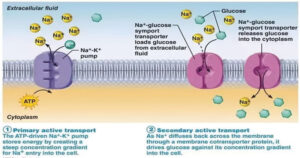
Active transport:
Movement against concentration gradient, requiring energy (ATP)
Endocytosis:
Engulfing substances into the cell through vesicle formation
Types; Phagocytosis, pinocytosis
Phagocytosis:
Engulfment of large particles or whole cells by phagocytes
Engulfment of bacteria by WBCs
Pinocytosis:
Ingestion of small fluid droplets and solutes by inward folding of cell membrane.
- g. Uptake of enzyme & hormones, Receptor-mediated endocytosis
Specific uptake of ligands bound to cell surface receptors, Uptake of LDL, etc.
Exocytosis:
Release of substances through vesicle fusion with the membrane.
- Example; Hormones, neurotransmitters, etc.