
CARDIOVASCULAR SYSTEM
The cardiovascular system is divided into two main parts.
- The circulatory system, consisting of the heart, which acts as a pump, and the blood vessels through which the blood circulates
- The lymphatic system, consisting of lymph nodes and lymph vessels, through which colourless lymph flows.
The heart pumps blood into two anatomically separate systems of blood vessels
- The pulmonary circulation
- The systemic circulation.
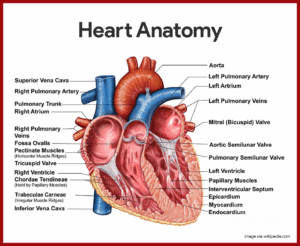
Human Heart has valves and cusps.The direction of blood flow through a valve. The cusps are semilunar in shape with the concavity towards the heart. Among the endothelial cells there may be many phagocytic macrophages, e.g. Kupffer cells in the liver. Oxygen is carried from the lungs to the tissues in chemical combination with haemoglobin as oxyhaemoglobin. The exchange in the tissues takes place between blood at the arterial end of the capillaries and the tissue, then between the tissue fluid and the cells.
Human Heart;
The heart lies in the thoracic cavity in the mediastinum between the lungs. It lies obliquely, a little more to the left than the right, and presents a base above, and an apex below. The apex is about 9 cm to the left of the midline at the level of the 5th intercostal space, i.e. a little below the nipple and slightly nearer the midline. The base extends to the level of the 2nd rib. Inferiorly — the apex rests on the central tendon of the diaphragm,
- Superiorly — the great blood vessels, i.e. the aorta, superior vena cava, pulmonary arter and pulmonary veins,
- Posteriorly — the oesophagus, trachea, left and right bronchus, descending aorta, inferior vena cava and thoracic vertebrae,
- Laterally — the lungs — the left lung overlaps the left side of the heart
- Anteriorly — the sternum, ribs and intercostal muscles
Structure; The heart is composed of three layers of tissue: pericardium, myocardium and endocardium. Pericardium The pericardium is made up of two sacs. The outer sac consists of fibrous tissue and the inner of a continuous double layer of serous membrane. The outer fibrous sac is continuous with the tunica adventitia of the great blood vessels above and is adherent to the diaphragm below.
Its inelastic, fibrous nature prevents overdistension of the heart. The outer layer of the serous membrane, the parietal pericardium, lines the fibrous sac. The inner layer, the visceral pericardium, or epicardium, which is continuous with the parietal pericardium, is adherent to the heart muscle. A similar arrangement of a double membrane forming a closed space is seen also with the pleura, the membrane enclosing the lungs. The serous membrane consists of flattened epithelial cells. It secretes serous fluid into the space between the visceral and parietal layers which allows smooth movement between them when the heart beats. The space between the parietal and visceral pericardium is only a potential space.
Myocardium; The myocardium is composed of specialised cardiac muscle found only in the heart. It is not under voluntary control (involuntary) but, like skeletal muscle, cross-stripes are seen on microscopic examination. Each fibre (cell) has a nucleus and one or more branches. Cardiac muscle, with fibres separated or intercalated discs can be seen as thicker, darker lines than the ordinary cross-stripes. This arrangement gives cardiac muscle the appearance of being a sheet of muscle rather than a very large number of individual cells. Because of the end-to-end continuity of the fibres, each one does not need to have a separate nerve supply. When an impulse is initiated it spreads from cell to cell via the branches and intercalated discs over the whole ‘sheet’ of muscle, causing contraction. The ‘sheet’ arrangement of the myocardium enables the atria and ventricles to contract in a coordinated and efficient manner. The myocardium is thickest at the apex and thins out towards the base. This reflects the amount of work each chamber contributes to the pumping of blood. It is thickest in the left ventricle. The atria and the ventricles are separated by a ring of fibrous tissue that does not conduct electrical impulses. Consequently, when a wave of electrical activity passes over the atrial muscle, it can only spread to the ventricles through the conducting system which bridges the fibrous ring from atria to ventricles.
Endocardium; This forms the lining of the myocardium and the heart valves. It is a thin, smooth, glistening membrane which permits smooth flow of blood inside the heart. It consists of flattened epithelial cells, continuous with the endothelium that lines the blood vessels.
Interior of the heart; The heart is divided into a right and left side by the septum. After birth blood cannot cross the septum from one side to the other. Each side is divided by an atrioventricular valve into an upper chamber, the atrium, and a lower chamber, the ventricle. The atrioventricular valves are formed by double folds of endocardium strengthened by a little fibrous tissue. The right atrioventricular valve (tricuspid valve) has three flaps or cusps and the left atrioventricular valve (mitral valve) has two cusps.The valves between the atria and ventricles open and close passively according to changes in pressure in the chambers. They open when the pressure in the atria is greater than that in the ventricles. During ventricular systole (contraction) the pressure in the ventricles rises above that in the atria and the valves snap shut prevent ing backward flow of blood. The valves are prevented from opening upwards into the atria by tendinous cords, called chordae tendineae, which extend from the inferior surface of the cusps to little projections of myocardium covered with endothelium, called papillary muscles.
Blood Flow through the heart; The two largest veins of the body, the superior and inferior venae cavae, empty their contents into the right atrium. This blood passes via the right atrioventricular valve into the right ventricle, and from there it is pumped into the pulmonary artery or trunk (the only artery in the body which carries deoxygenated blood).
The opening of the pulmonary artery is guarded by the pulmonary valve, formed by three semilunar cusps. This valve prevents the back flow of blood into the right ventricle when the ventricular muscle relaxes. After leaving the heart the pulmonary artery divides into left and right pulmonary arteries, which carry the venous blood to the lungs where exchange of gases takes place: carbon dioxide is excreted and oxygen is absorbed. Two pulmonary veins from each lung carry oxygenated blood back to the left atrium. Blood then passes through the left atrioventricular valve into the left ventricle, and from there it is pumped into the aorta.
General circulation; the opening of the aorta is guarded by the aortic valve, formed by three semilunar cusps. From this sequence of events it can be seen that the blood passes from the right to the left side of the heart via the lungs, or pulmonary circulation. However, it should be noted that both atria contract at the same time that this is followed by the simultaneous contraction of both ventricles. The muscle layer of the walls of the atria is very thin in comparison with that of the ventricles. This is consistent with the amount of work it does. The pulmonary trunk leaves the heart from the upper part of the right ventricle, and the aorta leaves from the upper part of the left ventricle.
Blood supply to the heart Arterial supply; The heart is supplied with arterial blood by the right and left coronary arteries which branch from the aorta immediately distal to the aortic valve. The coronary arteries receive about 5% of the blood pumped from the heart, although the heart comprises a small proportion of body weight. This large blood supply, especially to the left ventricle, highlights the importance of the heart to body function. Venous drainage; Most of the venous blood is collected into several small veins that join to form the coronary sinus which opens into the right atrium. . The remainder passes directly into the heart chambers through little venous channel.
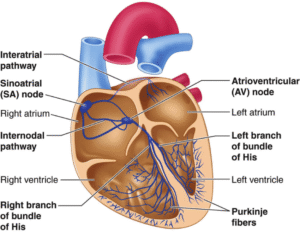
Sinoatrial node (SA node); this small mass of specialised cells is in the wall of the right atrium near the opening of the superior vena cava. The SA node is the ‘pace-maker’ of the heart because it normally initiates impulses more rapidly than other groups of neuromuscular cells.
Atrioventricular node (AV node); this small mass of neuromuscular tissue is situated in the wall of the atrial septum near the atrioventricular valves. Normally the AV node is stimulated by impulses that sweep over the atrial myocardium. However, it too is capable of initiating impulses that cause contraction but at a slower rate than the SA node.
Atrioventricular bundle (AV bundle or bundle of His); this is a mass of specialised fibres that originate from the AV node. The AV bundle crosses the fibrous ring that separates atria and ventricles then, at the upper end of the ventricular septum; it divides into right and left bundle branches. Within the ventricular myocardium the branches break up into fine fibres, called the Purkinje fibres. The AV bundle, bundle branches and Purkinje fibres convey electrical impulses from the AV node to the apex of the myocardium where the wave of ventricular contraction begins, then sweeps upwards and outwards, pumping blood into the pulmonary artery and the aorta.
The cardiovascular centre (CVC) is a collection of interconnected neurones in the brain and is situated within the medulla and pons.
The CVC receives, integrates and coordinates inputs from:
- Baroreceptors (pressure receptors)
- Chemoreceptors
- Higher centres in the brain.
A rise in blood pressure in arteries stimulates the baro receptors, increasing their input to the CVC. The CVC responds by increasing parasympathetic nerve activity to the heart; this slows the heart down. At the same time, sympathetic stimulation to the blood vessels is inhibited, causing vasodilatation. The net result is a fall in systemic blood pressure.
The pulse is a wave of distension and elongation felt in an artery wall due to the contraction of the left ventricle forcing about 60 to 80 millilitres of blood through the already full aorta and into the arterial system. When the aorta is distended, a wave passes along the walls of the arteries and can be felt at any point where a superficial artery can be pressed gently against a bone. An average of 60 to 80 is common at rest.
Aorta; The aorta begins at the upper part of the left ventricle and, after passing upwards for a short way, it arches backwards and to the left. It then descends behind the heart through the thoracic cavity a little to the left of the thoracic vertebrae. At the level of the 12th thoracic vertebra it passes behind the diaphragm then down wards in the abdominal cavity to the level of the 4th lum bar vertebra, where it divides into the right and left common iliac arteries. Throughout its length the aorta gives off numerous branches. Some of the branches are paired, i.e. there is a right and left branch of the same name, for instance, the right and left renal arteries supplying the kidneys, and some are single or unpaired, e.g. the coeliac artery.
Thoracic aorta; This part of the aorta is above the diaphragm and is described in three parts:
- ascending aorta
- arch of the aorta
- Descending aorta in the thorax.
Ascending aorta; This is about 5 cm long and lies behind the sternum. The right and left coronary arteries are its only branches and they arise from the aorta just above the level of the aortic valve.
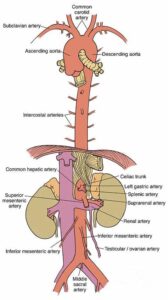
Arch of the aorta; The arch of the aorta is a continuation of the ascending aorta. It begins behind the manubrium of the sternum and runs upwards, backwards and to the left in front of the trachea. It then passes downwards to the left of the trachea and is continuous with the descending aorta. Three branches are given off from its upper aspect;
- Brachiocephalic artery or trunk
- left common carotid artery
- Left subclavian artery.
The brachiocephalic artery is about 4 to 5 cm long and passes obliquely upwards, backwards and to the right. At the level of the sternoclavicular joint it divides into the right common carotid artery and the right subclavian artery.
Circulation of blood to the head and neck;
Arterial supply; The paired arteries supplying the head and neck are the common carotid arteries and the vertebral arteries.
Carotid arteries; The right common carotid artery is a branch of the brachiocephalic artery. The left common carotid artery arises directly from the arch of the aorta. They pass upwards on either side of the neck and have the same distribution on each side. The common carotid arteries are embedded in fascia, called the carotid sheath. At the level of the upper border of the thyroid cartilage they divide into:
- External carotid artery
- Internal carotid artery.
The carotid sinuses are slight dilatations at the point of division (bifurcation) of the common carotid arteries into their internal and external branches. The walls of the sinuses are thin and contain numerous nerve endings of the glossopharyngeal nerves. These nerve endings, or baroreceptors, are stimulated by changes in blood pressure in the carotid sinuses. The resultant nerve impulses initiate reflex adjustments of blood pressure through the vasomotor centre in the medulla oblongata. The carotid bodies are two small groups of specialised cells, called chemoreceptors, one lying in close association with each common carotid artery at its bifurcation. They are supplied by the glossopharyngeal nerves and their cells are stimulated by changes in the carbon dioxide and oxygen content of blood. The resultant nerve impulses initiate reflex adjustments of respiration through the res piratory centre in the medulla oblongata. External carotid artery; This artery supplies the superficial tissues of the head and neck, via a number of branches
- The superior thyroid artery supplies the thyroid gland and adjacent muscles.
- The lingual artery supplies the tongue, the lining membrane of the mouth, and the structures in the floor of the mouth, the tonsil and the epiglottis.
- The facial artery passes outwards over the mandible just in front of the angle of the jaw and supplies the muscles of facial expression and structures in the mouth. The pulse may be felt where the artery crosses the jaw bone.
- The occipital artery supplies the posterior part of the scalp.
- The temporal artery passes upwards over the zygomatic process in front of the ear and supplies the frontal, temporal and parietal parts of the scalp. The pulse may be felt in front of the upper part of the ear.
- The maxillary artery supplies the muscles of mastication and a branch of this artery, the middle meningeal artery, runs deeply to supply structures in the interior of the skull.
Internal carotid artery; The internal carotid artery is a major contributor to the circulus arteriosus (circle of Willis) which supplies the greater part of the brain. It also has branches that supply the eyes, forehead and nose. It ascends to the base of the skull and passes through the carotid foramen in the temporal bone. Circulus arteriosus (circle of Willis). The greater part of the brain is supplied with arterial blood by an arrangement of arteries called the circulus arteriosus or the circle of Willis. Four large arteries contribute to its formation: two internal carotid arteries and two vertebral arteries. The vertebral arteries arise from the subclavian arteries, pass upwards through the foramina in the transverse processes of the cervical vertebrae, enter the skull through the foramen magnum, then join to form the basilar artery. The arrangement in the circulus arterio sus (circle of Willis) is such that the brain as a whole receives an adequate blood supply when a contributing artery is damaged and during extreme movements of the head and neck. Anteriorly, two anterior cerebral arteries arise from the internal carotid arteries and are joined by the anterior communicating artery. Posteriorly, two vertebral arteries join to form the basilar artery.
After travelling for a short distance the basilar artery divides to form two posterior cerebral arteries, each of which is joined to the corresponding internal carotid artery by a posterior communicating artery, completing the circle.
The circulus arteriosus is therefore formed by:
- 2 anterior cerebral arteries
- 2 internal carotid arteries
- 1 anterior communicating artery
- 2 posterior communicating arteries
- 2 posterior cerebral arteries
- 1 basilar artery.
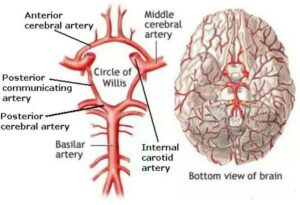
From this circle, the anterior cerebral arteries pass forward to supply the anterior part of the brain, the middle cerebral arteries pass laterally to supply the sides of the brain, and the posterior cerebral arteries supply the posterior part of the brain. Branches of the basilar artery supply parts of the brain stem.
Venous return from the head and neck; The venous blood from the head and neck is returned by deep and superficial veins. Superficial veins with the same names as the branches of the external carotid artery return venous blood from the superficial structures of the face and scalp and unite to form the external jugular vein. The external jugular vein begins in the neck at the level of the angle of the jaw. It passes downwards in front of the sternocleidomastoid muscle, then behind the clavicle before entering the subclavian vein. The venous blood from the deep areas of the brain is collected into channels called the dural venous sinuses. The dural venous sinuses of the brain are formed by layers of dura mater lined with endothelium. The dura mater is the outer protective covering of the brain.
The main venous sinuses are:
- 1 superior sagittal sinus
- 1 inferior sagittal sinus
- 1 straight sinus
- 2 transverse or lateral sinuses
- 2 sigmoid sinuses
The superior sagittal sinus carries the venous blood from the superior part of the brain. It begins in the frontal region and passes directly backwards in the midline of the skull to the occipital region where it turns to the right side and continues as the right transverse sinus.
The inferior sagittal sinus lies deep within the brain and passes backwards to form the straight sinus. The straight sinus runs backwards and downwards to become the left transverse sinus. The transverse sinuses begin in the occipital region. They run forward and medially in a curved groove of the skull, to become continuous with the sigmoid sinuses. The sigmoid sinuses are a continuation of the transverse sinuses. Each curves downwards and medially and lies in a groove in the mastoid process of the temporal bone. Anteriorly only a thin plate of bone separates the sinus from the air cells in the mastoid process of the temporal. The internal jugular veins begin at the jugular foramina in the middle cranial fossa and each is the continuation of a sigmoid sinus. They run downwards in the neck behind the sternocleidomastoid muscles. Behind the clavicle they unite with the subclavian veins, carrying blood from the upper limbs, to form the brachiocephalic veins. The brachiocephalic veins are situated one on each side in the root of the neck. Each is formed by the union of the internal jugular and the subclavian veins. The left brachiocephalic vein is longer than the right and passes obliquely behind the manubrium of the sternum, where it joins the right brachiocephalic vein to form the superior vena cava.
The superior vena cava; which drains all the venous blood from the head, neck and upper limbs, is about 7 cm long. It passes downwards along the right border of the sternum and ends in the right atrium of the heart.
Circulation of blood to the upper limb;
Arterial supply;
The subclavian arteries; The right subclavian artery arises from the brachiocephalic artery; the left branches from the arch of the aorta. They are slightly arched and pass behind the clavicles and over the first ribs before entering the axillae, where they continue as the axillary arteries.Before entering the axilla each subclavian artery gives off two branches: the vertebral artery, which passes upwards to supply the brain, and the internal thoracic artery, which supplies the breast and a number of structures in thoracic in cavity.
The axillary artery is a continuation of the subclavian artery and lies in the axilla. The first part lies deeply; then it runs more superficially to become the brachial artery. The brachial artery is a continuation of the axillary artery. It runs down the medial aspect of the upper arm, passes to the front of the elbow and extends to about 1 cm below the joint, where it divides into radial and ulnar arteries. The radial artery passes down the radial or lateral side of the forearm to the wrist. Just above the wrist it lies superficially and can be felt in front of the radius, where the radial pulse is palpable. The artery then passes between the first and second metacarpal bones and enters the palm of the hand. The ulnar artery runs downwards on the ulnar or medial aspect of the forearm to cross the wrist and passes into the hand. There are anastomoses between the radial and ulnar arteries, called the deep and superficial palmar arches, from which palmar metacarpal and palmar digital arteries arise to supply the structures in the hand and fingers. Branches from the axillary, brachial, radial and ulnar arteries supply all the structures in the upper limb.
The main veins of the right arm; Dark blue indicates deep veins. The veins of the upper limb are divided into two groups: deep and superficial veins. The deep veins follow the course of the arteries and have the same names:
- palmar metacarpal veins
- deep palmar venous arch
- ulnar and radial veins
- brachial vein
- axillary vein
- Subclavian vein.
The superficial veins begin in the hand and consist of the following:
- Cephalic vein
- Basilic vein
- Median vein
- Median cubital vein.
The cephalic vein begins at the back of the hand where it collects blood from a complex of superficial veins, many of which can be easily seen. It then winds round the radial side to the anterior aspect of the forearm.
In front of the elbow it gives off a large branch, the mediancubitalvein, which slants upwards and medially to join the basilic vein. After crossing the elbow joint the cephalic vein passes up the lateral aspect of the arm and in front of the shoulder joint to end in the axillary vein. Throughout its length it receives blood from the superficial tissues on the lateral aspects of the hand, forearm and arm. The basilic vein begins at the back of the hand on the ulnar aspect. It ascends on the medial side of the forearm and upper arm then joins the axillary vein. It receives blood from the medial aspect of the hand, forearm and arm. There are many small veins which link the cephalic and basilic veins.
The median vein is a small vein that is not always present. It begins at the palmar surface of the hand, ascends on the front of the forearm and ends in the basilic vein or the median cubital vein. The brachiocephalic vein is formed when the subclavian and internal jugular veins unite. There is one on each side.
The superior vena cava is formed when the two brachio cephalic veins unite. It drains all the venous blood from the head, neck and upper limbs and terminates in the right atrium. It is about 7 cm long and passes downwards along the right border of the sternum.
Descending aorta in the thorax; This part of the aorta is continuous with the arch of the aorta and begins at the level of the 4th thoracic vertebra. It extends downwards on the anterior surface of the bodies of the thoracic vertebrae to the level of the 12th thoracic vertebra, where it passes behind the diaphragm to become the abdominal aorta. The descending aorta in the thorax gives off many paired branches which supply the walls of the thoracic cavity and the organs within the cavity, including:
- bronchial arteries that supply the bronchi and their branches, connective tissue in the lungs and the lymph nodes at the root of the lungs
- oesophageal arteries that supply the oesophagus
- Intercostal arteries that run along the inferior border of the ribs and supply the intercostal muscles, some muscles of the thorax, the ribs, the skin and its underlying connective tissues.
Venous return from the thoracic cavity;
Most of the venous blood from the organs in the thoracic cavity is drained into the azygos vein and the hemiazygos vein. Some of the main veins which join them are the bronchial, oesophageal and intercostalveins.
The main branches of azygos veins are;
- Hemizygius vein,
- Accessory hemizygous vein,
- Right posterior intercostal vein.
These tributaries drain blood from the intercostal spaces, mediastinum, and other thoracoic structures, ultimately delivering it to the Superior Vena Cava via the azygous vein.
The azygos vein joins the superior vena cava and the hemiazygos vein joins the left brachiocephalic vein. At the distal end of the oesophagus some oesophageal veins join the azygos vein and others, the left gastric vein. A venous plexus is formed by anastomoses between the veins joining the azygos vein and those joining the left gastric veins, linking the general and portal circulations.
Abdominal aorta; The abdominal aorta is a continuation of the thoracic aorta. The name changes when the aorta enters the abdominal cavity by passing behind the diaphragm at the level of the 12th thoracic vertebra. It descends in front of the bodies of the vertebrae to the level of the 4th lumbar vertebra, where it divides into the right and left common iliac arteries.
Many branches arise from the abdominal aorta, some of which are paired and some unpaired.
Paired branches;
- Inferior phrenic arteries; supply the diaphragm.
- Renal arteries; supply the kidneys and give off branches, the suprarenal arteries, to supply the adrenal glands.
- Testicular arteries; supply the testes in the male.
- Ovarian arteries; supply the ovaries in the female.
The testicular and ovarian arteries are much longer than the other paired branches. This is because the testes and the ovaries begin their development in the region of the kidneys. As they grow they descend into the scrotum and the pelvis respectively and are accompanied by their blood vessels.
Unpaired branches;
Coeliac artery; is a short thick artery about 1.25 cm long. It arises immediately below the diaphragm and divides into three branches:
- Left gastric artery; supplies the stomach.
- Splenic artery; supplies the pancreas and the spleen.
- Hepatic artery; supplies the liver, gall bladder and part the stomach, duodenum and pancreas.
Superior mesenteric artery; branches from the aorta between the coeliac artery and the renal arteries. It supplies the whole of the small intestine and the proximal half of the large intestine.
Inferior mesenteric artery; arises from the aorta about 4 cm above its division into the common iliac arteries. It supplies the distal half of the large intestine and part of the rectum.
Venous return from the abdominal organs;
The inferior vena cava is formed when right and left common iliac veins join at the level of the body of the 5th lumbar vertebra. This is the largest vein in the body and it conveys blood from all parts of the body below the diaphragm to the right atrium of the heart. It passes through the central tendon of the diaphragm at the level of the 8th thoracic vertebra. Paired testicular, ovarian, renal and adrenal veins join the inferior vena cava.Blood from the remaining organs in the abdominal cavity passes through the liver via the portal circulation before entering the inferior vena cava.
Portal circulation; In the portal circulation, venous blood passes from the capillary beds of the abdominal part of the digestive system, the spleen and pancreas to the liver. It passes through a second capillary bed, the hepatic sinusoids, in the liver before entering the general circulation via the inferior vena cava. In this way blood with a high concentration of nutrients, absorbed from the stomach and intestines, goes to the liver first. In the liver certain modifications take place, including the regulation of nutrient supply to other parts of the body.
Portal vein; this is formed by the union of the following veins, each of which drains blood from the area supplied by the corresponding artery: splenic vein, inferior mesenteric vein, superior mesenteric vein, gastric veins and cystic vein. The splenic vein drains blood from the spleen, the pancreas and part of the stomach. The inferior mesenteric vein returns the venous blood from the rectum, pelvic and descending colon of the large intestine. It joins the splenic vein. The superior mesenteric vein returns venous blood from the small intestine and the proximal parts of the large intestine, i.e. the caecum, ascending and transverse colon.
Superior mesenteric vein unites with the splenic vein to form the portal vein. The gastric veins drain blood from the stomach and the distal end of the oesophagus, and then join the portal vein. The cystic vein which drains venous blood from the gall bladder joins the portal vein.
Hepatic veins; These are very short veins that leave the posterior surface of the liver and, almost immediately, enter the inferior vena cava.
Circulation of blood to the pelvis and lower limb;
Arterial supply;
Common iliac arteries; The right and left common iliac arteries are formed when the abdominal aorta divides at the level of the 4th lumbar vertebra. In front of the sacroiliac joint each divides into:
- Internal iliac artery.
- External iliac artery.
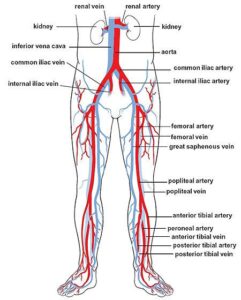
The internal iliac artery runs medially to supply the organs within the pelvic cavity. In the female, one of the largest branches is the uterine artery which provides the main arterial blood supply to the reproductive organs.
The external iliac artery runs obliquely downwards and passes behind the inguinal ligament into the thigh where it becomes the femoral artery.
The femoral artery; begins at the midpoint of the inguinal ligament and extends downwards in front of the thigh; then it turns medially and eventually passes.The femoral artery and its main branches around the medial aspect of the femur to enter the popliteal space where it becomes the popliteal artery. It supplies blood to the structures of the thigh and some superficial pelvic and inguinal structures.
The popliteal artery; passes through the popliteal fossa behind the knee. It supplies the structures in this area, including the knee joint. At the lower border of the popliteal fossa it divides into the anterior and posterior tibial arteries.
The anterior tibial artery; passes forwards between the tibia and fibula and supplies the structures in the front of the leg. It lies on the tibia, runs in front of the ankle joint and continues over the dorsum (top) of the foot as the dorsalis pedis artery.
The dorsalis pedis artery; is a continuation of the anterior tibial artery and passes over the dorsum of the foot, supplying arterial blood to the structures in this area. It ends by passing between the first and second metatarsal bones into the sole of the foot where it contributes to the formation of the plantar arch.
The posterior tibial artery; runs downwards and medially on the back of the leg. Near its origin it gives off a large branch called the peroneal artery which supplies the lateral aspect of the leg. In the lower part it becomes superficial and passes medial to the ankle joint to reach the sole of the foot where it continues as the plantar artery
The plantar artery; supplies the structures in the sole of the foot. This artery, its branches and the dorsalis pedis artery form the plantar arch from which the digital branches arise to supply the toes.
Venous return;
There are both deep and superficial veins in the lower limb. Blood entering the superficial veins passes to the deep veins through communicating veins. Movement of blood towards the heart is partly dependent on contraction of skeletal muscles. Backward flow is prevented by a large number of valves. Superficial veins receive less support by surrounding tissues than deep veins.
Deep veins; The deep veins accompany the arteries and their branches and have the same names.
Digital veins; Plantar venous arch posterior tibial vein anterior tibial vein popliteal vein femoral vein external iliac vein internal iliac vein common iliac vein.
The femoral vein ascends in the thigh to the level of the inguinal ligament where it becomes the external iliac vein.
The external iliac vein is the continuation of the femoral vein where it enters the pelvis lying close to the femoral artery. It passes along the brim of the pelvis.
The cardiovascular system level of the sacroiliac joint it is joined by the internal iliac vein to form the common iliac vein. The internal iliac vein receives tributaries from several veins which drain the organs of the pelvic cavity. The two common iliac veins begin at the level of the sacroiliac joints. They ascend obliquely and end a little to the right of the body of the 5th lumbar vertebra by uniting to form the inferior vena cava.
Superficial veins; The two main superficial veins draining blood from the lower limbs are:
- Small saphenous vein
- Great saphenous vein.
The small saphenous vein begins behind the ankle joint where many small veins which drain the dorsum of the foot join together. It ascends superficially along the back of the leg and in the popliteal space it joins the popliteal vein — a deep vein.
The great saphenous vein is the longest vein in the body. It begins at the medial half of the dorsum of the foot and runs upwards, crossing the medial aspect of the tibia and up the inner side of the thigh. Just below the inguinal ligament it joins the femoral vein. Many communicating veins join the superficial veins and the superfacial and the deep of the lower limbs.