
INTEGUMENTARY SYSTEM
The skin completely covers the body and is continuous with the membranes lining the body orifices. It:
- protects the underlying structures from injury and from invasion by microbes
- contains sensory (somatic) nerve endings of pain, temperature and touch
- Involved in the regulation of body temperature.
Structure of the skin;
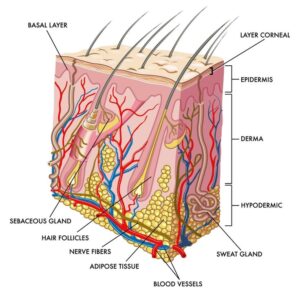
The skin has a surface area of about 1.5 to 2 metersin adultsand it contains glands, hair and nails. There are two mainlayers:
- Epidermis
- Dermis
Between the skin and underlying structures there is a layer of subcutaneous fat.
Epidermis;
The epidermis is the most superficial layer of the skin and is composed of stratified keratinised squamous epithelium which varies in thickness in different parts of the body. It is thickest on the palms of the hands and soles of the feet. There are no blood vessels or nerve endings in the epidermis, but its deeper layers are bathed in interstitial fluid from the dermis, which provides oxygen and nutrients, and is drained away as lymph.
There are several layers (strata) of cells in the epidermis which extend from the deepest germinative layer to the surface stratum corneum (a thick horny layer). The cells on the surface are flat, thin, non-nucleated, dead cells, or squames, in which the cytoplasm has been replaced by the fibrous protein keratin. These cells are constantly being rubbed off and replaced by cells which originated in the germinative layer and have undergone gradual change as they progressed towards the surface.
Complete replacement of the epidermis takes about 40 days.
The maintenance of healthy epidermis depends upon three processes being synchronised:
- Desquamation (shedding) of the keratinised cells from the surface
- Effective keratinisation of the cells approaching the surface
- Continual cell division in the deeper layers with newly formed cells being pushed to the surface.
Hairs, secretions from sebaceous glands and ducts of sweat glands pass through the epidermis to reach the surface.
The surface of the epidermis is ridged by projections of cells in the dermis called the papillae. The pattern of ridges is different in every individual and the impression made by them is the ‘fingerprint’. The downward projections of the germinative layer between the papillae are believed to aid nutrition of epidermal cells and stabilize the two layers, preventing damage due to shearing forces. Blisters develop when acute trauma causes separation of the dermis and epidermis and serous fluid collects between the two layers.
The colour of the skin is affected by three main factors.
- Melanin, a dark pigment derived from the amino acid tyrosine and secreted by melanocytes in the deep germinative layer, is absorbed by surrounding epithelial cells. The amount is genetically determined and varies between different parts of the body, between members of the same race and between races. The number of melanocytes is fairly constant so the differences in colour depend on the amount of melanin secreted. It protects the skin from the harmful effects of sunlight. Exposure to sunlight promotes synthesis of increased amounts of melanin.
- Level of oxygenation of haemoglobin and the amount of blood circulating in the dermis give the skin its pink colour.
- Bile pigments in blood and carotenes in subcutaneous fat give the skin a yellowish colour.
Dermis;
The dermis is tough and elastic. It is formed from connective tissue and the matrix contains collagen fibres interlaced with elastic fibres. Rupture of elastic fibres occurs when the skin is overstretched, resulting in permanent striae, or stretch marks, that may be found in pregnancy and obesity. Collagen fibres bind water and give the skin its tensile strength, but as this ability declines with age, wrinkles develop. Fibroblasts, macrophages and mast cells are the main cells found in the dermis. Underlying its deepest layer there is areolar tissue and varying amounts of adipose tissue (fat). The structures in the dermis are:
- blood vessels
- lymph vessels
- sensory (somatic) nerve endings
- sweat glands and their ducts
- Hairs, arrector pili muscles and sebaceous glands.
Blood vessels; Arterioles form a fine network with capillary branches supplying sweat glands, sebaceous glands, hair follicles and the dermis. The epidermis has no blood supply. It obtains nutrients and oxygen from interstitial fluid derived from blood vessels in the papillae of the dermis.
Lymph vessels; These form a network throughout the dermis.
Sensory nerve endings; Sensory receptors (specialized nerve endings) which are sensitive to touch, change in temperature, pressure and pain are widely distributed in the dermis. Incoming stimuli activate different types of sensory receptors. The skin is an important sensory organ through which individuals receive information about their environment.
Nerve impulses; generated in the sensory receptors in the dermis, are conveyed to the spinal cord by sensory (somatic cutaneous) nerves, then to the sensory area of the cerebrum where the sensations are perceived.
Sweat glands; Sweat glands are found widely distributed throughout the skin and are most numerous in the palms of thehands, soles of the feet, axillae and groins. They are composed of epithelial cells. The bodies of the glands lie coiled in the subcutaneous tissue. Some ducts open ontothe skin surface at tiny depressions, or pores, and othersopen into hair follicles. Glands opening into hair folliclesdo not become active until puberty. In the axilla theysecrete an odourless milky fluid which, if decomposed bysurface microbes, causes an unpleasant odour. The functions of this secretion are not known. Sweat glands are stimulated by sympathetic nerves in response to raisedbody temperature and fear.
The colour of the hair is genetically determined and depends on the amount of melanin present. White hair is the result of the replacement of melanin by tiny air bubbles.
The arrector pili; These are little bundles of smooth muscle fibres attached to the hair follicles. Contraction makes the hair stand erect and raises the skin around the hair, causing ‘goose flesh’. The muscles are stimulated by sympathetic nerve fibres in response to fear and cold. Erect hairs trap air, which acts as an insulating layer. This is an efficient warming mechanism especially when accompanied by shivering, i.e. involuntary contraction of the skeletal muscles.
The sebaceous glands; These consist of secretory epithelial cells derived from the same tissue as the hair follicles. They secrete an oily substance, sebum, into the hair follicles and are therefore present in the skin of all parts of the body except the palms of the hands and the soles of the feet. They are most numerous in the skin of the scalp, face, axillae and groins. In regions of transition from one type of superficial epithelium to another, such as lips, eyelids, nipple, labia minora and glans penis, there are sebaceous glands that are independent of hair follicles, secreting sebum directly on to the surface.
Sebum keeps the hair soft and pliable and gives it a shiny appearance. On the skin it provides some water-proofing and acts as a bactericidal and fungicidal agent, preventing the successful invasion of microbes. It also prevents drying and cracking of skin, especially on exposure to heat and sunshine. The activity of these glands increases at puberty and is less at the extremes of age, rendering infants and the elderly prone to the effects of excessive moisture, e.g. nappy rash in infants.
Nails;
The nails in human beings are equivalent to the claws, horns and hoofs of animals. They are derived from the same cells as epidermis and hair and consist of a hard, horny keratin plate. They protect the tips of the fingers and toes. The root of the nail is embedded in the skin, is covered by the cuticle and forms the hemispherical pale area called the lunula.
The nail plate of the nail is the exposed part that has grown out from the germinative zone of the epidermis called the nail bed. Finger nails grow more quickly than toe nails and growth is quicker when the environmental temperature is high.
Nervous control; The temperature regulating centre in the hypothalamus is responsive to the temperature of circulating blood. This centre controls body temperature through autonomic nerve stimulation of the sweat glands. When body temperature rises, the vasomotor centre in the medulla oblongata controls the diameter of the small arteries and arterioles, and therefore the amount of blood which circulates in the capillaries in the dermis. The vasomotor centre is influenced by the temperature of its blood supply and by nerve impulses from the hypothalamus. When body temperature rises the skin capillaries dilate and the extra blood near the surface increases heat loss by radiation, conduction and convection. The skin is warm and pink in color. When body temperature falls arteriolar constriction conserves heat and the skin is whiter and feels cool.