
LYMPHATIC SYSTEM
LYMPH VESSELS; These originate as blind-end tubes in the interstitial spaces. They have the same structure as blood capillaries, i.e. a single layer of endothelial cells, but their walls are more permeable to all interstitial fluid constituents, including proteins and cell debris. The tiny capillaries join up to form larger lymph vessels. All tissues of the body have a network of lymphatic vessels, with the exception of the central nervous system, the bones and the most superficial layers of the skin.
Larger lymph vessels; The walls of lymph vessels are about the same thickness as those of small veins and have the same layers of tissue, i.e. a fibrous covering, a middle layer of smooth muscle and elastic tissue and an inner lining of endothelium. Lymph vessels have numerous cup-shaped valves which ensure that lymph flows in one way only, i.e. towards the thorax. There is no ‘pump’, like the heart, involved in the onward movement of lymph but the muscle tissue in the walls of the large lymph vessels has an intrinsic ability to contract rhythmically (the lymphatic pump). In addition, any structure that periodically compresses the lymphatic vessels can assist in the movement of lymph along the vessels, commonly including the contraction of adjacent muscles and the pulsation of large arteries. Lymph vessels become larger as they join together, eventually forming two large ducts, the thoracic duct and right lymphatic duct, that empty lymph into the subclavian veins.
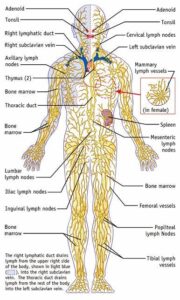
Thoracic duct; this duct begins at the cisterna chyli, which is a dilated lymph channel situated in front of the bodies of the first two lumbar vertebrae. The duct is about 40 cm long and opens into the left subclavian vein in the root of the neck. It drains lymph from both legs, the pelvic and abdominal cavities, the left half of the thorax, head and neck and the left arm.
Right lymphatic duct; This is a dilated lymph vessel about 1 cm long. It lies in the root of the neck and opens into the right subclavian vein. It drains lymph from the right half of the thorax, head and neck and the right arm.
LYMPHATIC ORGANS AND TISSUES; Lymph nodes are oval or bean-shaped organs that lie, often in groups, along the length of lymph vessels. The lymph drains through a number of nodes, usually 8 to 10, before returning to the venous circulation. These nodes vary considerably in size: some are as small as a pin head and the largest are about the size of an almond.
Structure of lymph nodes;
Lymph nodes; have an outer capsule of fibrous tissue which dips down into the node substance forming partitions, or tmbeculae. The main substance of the node consists of reticular and lymphatic tissue containing many lymphocytes and macrophages. As many as four or five afferent lymph vessels may enter a lymph node while only one efferent vessel carries lymph away from the node. Each node has a concave surface called the hilum where an artery enters and a vein and the efferent lymph vessel leave. The large numbers of lymph nodes situated in strate gic positions throughout the body are arranged in deep and superficial groups. Lymph from the head and neck passes through deep and superficial cervical nodes.The spleen.
Lymph nodes of the face and neck; Lymph from the upper limbs passes through nodes situated in the elbow region then through the deep and superficial axillary nodes.
Lymph from organs and tissues in the thoracic cavity drains through groups of nodes that are situated close to the mediastinum, large airways, and Oesophagus and chest wall. Most of the lymph from the breast passes through the axillary nodes. Lymph from the pelvic and abdominal cavities passes through many lymph nodes before entering the cisterna chyli. The abdominal and pelvic nodes are situated mainly in association with the blood vessels supplying the organs and close to the main arteries, i.e. the aorta and the external and internal iliac arteries. The lymph from the lower limbs drains through deep and superficial nodes including groups of nodes behind the knee and in the groin (inguinal nodes).
Tonsils; These are located in the mouth and throat, and will destroy swallowed and inhaled antigens, Peyer’s patches. These large collections of lymphoid tissue are found in the small intestine, and intercept swallowed antigens.