
MUSCULAR SYSTEM
Skeletal muscles not involved in the movements of the joints of the limbs. There are many muscles involved in changing facial expression and with movement of the lower jaw during chewing and speaking.
Occipitofrontalis (unpaired); this consists of a posterior muscular part over the occipital bone (ocdpitalis), an anterior part over the frontal bone (frontalis) and an extensive flat tendon or aponeurosis that stretches over the dome of the skull and joins the two muscular parts. It raises the eyebrows.
Levator palpebrae superioris; This muscle extends from the posterior part of the orbital cavity to the upper eyelid. It raises the eyelid.
Orbicularis oculi; This muscle surrounds the eye, eyelid and orbital cavity. It closes the eye and when strongly contracted ‘screws up’ the eyes.
Buccinator; This flat muscle of the cheek draws the cheeks in towards the teeth in chewing and in forcible expulsion of air from the mouth (‘the trumpeter’s muscle’)
Orbicularis oris (unpaired); this muscle surrounds the mouth and blends with the muscles of the cheeks. It closes the lips and, when strongly contracted, shapes the mouth for whistling.
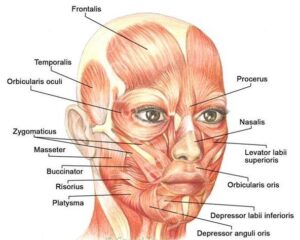
Masseter; This is a broad muscle, extending from the zygomatic arch to the angle of the jaw. In chewing it draws the mandible up to the maxilla, closing the jaw, and exerts considerable pressure on the food.
Temporalis; This muscle covers the squamous part of the temporal bone. It passes behind the zygomatic arch to be inserted into the coronoid process of the mandible. It closes the mouth and assists with chewing.
Pterygoid; This muscle extends from the sphenoid bone to the mandible. It closes the mouth and pulls the lower jaw forward. Muscles of the neck There are many muscles situated in the neck but only the two largest are considered here.
Sternocleidomastoid; This muscle arises from the manubrium of the sternum and the clavicle and extends up wards to the mastoid process of the temporal bone. It assists in turning the head from side to side. When the muscle on one side contracts it draws the head towards the shoulder. When both contract at the same time they flex the cervical vertebrae or draw the sternum and clavicles upwards when the head is maintained in a fixed position, e.g. in forced respiration.
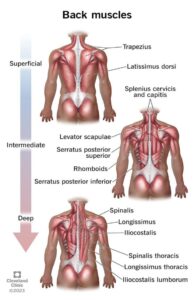
Trapezius; This muscle covers the shoulder and the back of the neck. The upper attachment is to the occipital protuberance, the medial attachment is to the transverse processes of the cervical and thoracic vertebrae and the lateral attachment is to the clavicle and to the spinous and acromion processes of the scapula. It pulls the head backwards, squares the shoulders and controls the move ments of the scapula when the shoulder joint is in use.
MUSCLES OF THE BACK;
There are six pairs of large muscles in the back in addition to those that form the posterior abdominal wall. The arrangement of these muscles is the same on each side of the vertebral column.
Quadratus lumborum; This muscle originates from the iliac crest then it passes upwards, parallel and close to the vertebral column and it is inserted into the 12th rib Together the two muscles fix the lower rib during respiration and cause extension of the vertebral column (bending backwards). If one muscle contracts it causes lateral flexion of the lumbar region of the vertebral column.
Sacrospinalis (erector spinae); this is a group of muscles lying between the spinous and transverse processes of the vertebrae. They originate from the sacrum and are finally inserted into the occipital bone. Their contraction causes extension of the vertebral column.
MUSCLES OF THE ABDOMINAL WALL;
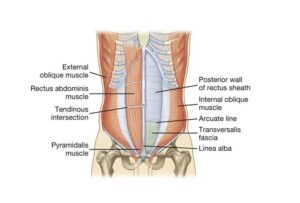
There are six pairs of muscles that form the abdominal wall.From the surface inwards they are:
- Rectus abdominis
- External oblique
- Internal oblique
- Transversus abdominis
- Quadratus lumborum
- Psoas
Transversus abdominis; This is the deepest muscle of the abdominal wall.The fibres arise from the iliac crest. The deep muscles of the posterior abdominal wall, process of the sternum to the symphysis pubis.
Rectus abdominis; This is the most superficial muscle. It is broad and flat, originating from the transverse part of the pubic bone then passing upwards to be inserted into the lower ribs and the xiphoid process of the sternum.
External oblique; This muscle extends from the lower ribs downwards and forward to be inserted into the iliac crest and, by an aponeurosis, to the linea Alba.
Internal oblique; This muscle lies deep to the external oblique. Its fibres arise from the iliac crest and by a broad band of fascia from the spinous processes of the lumbar vertebrae. The fibres pass upwards towards the midline to be inserted into the lower ribs and, by an aponeurosis, into the linea Alba. The fibres are at right angles to those of the external oblique.
Functions; The main function of the four pairs of muscles is to form the strong muscular anterior wall of the abdominal cavity. When the muscles contract together
- compress the abdominal organs
- Flex the vertebral column in the lumbar region.
Contraction of the muscles on one side only bends the trunk towards that side. Contraction of the oblique muscles on one side rotates the trunk.
Inguinal canal; This canal is 2.5 to 4 cm long and passes obliquely through the abdominal wall. It runs parallel to and immediately in front of the transversalis fascia and part of the inguinal ligament. In the male it contains the spermatic cord and in the female, the round ligament. It constitutes a weak point in the otherwise strong abdominal wall through which herniation may occur. The muscles are:
- Levator ani
Levator ani; This is a broad flat muscle, forming the anterior part of the pelvic floor. They originate from the inner surface of the true pelvis and unite in the midline. Together they form a sling which supports the pelvic organs.
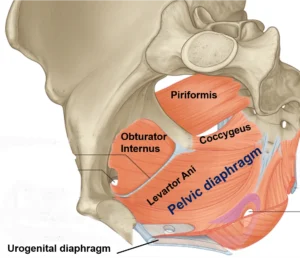
Coccygeus; This is a triangular sheet of muscle and tendinous fibres situated behind the levator ani. They originate from the medial surface of the ischium and are inserted into the sacrum and coccyx. They complete the formation of the pelvic floor which is perforated in the male by the urethra and anus and in the female by the urethra, vagina and anus.The pelvic floor supports the organs of the pelvis and maintains continence, i.e. it resists raised intrapelvic pressure during micturition and defaecation