
MUSCULOSKELETAL SYSTEM
Bone is a strong and durable type of connective tissue. It consists of:
- Water (25%)
- Organic constituents including osteoid (the carbon containing part of the matrix) and bone cells (25%)
- Inorganic constituents, mainly calcium phosphate (50%)
Types of bones: Bones are classified as long, short, irregular, flat and sesamoid.
Long bones: These consist of a shaft and two extremities. As the name suggests the length is much greater than the width. Examples include the femur, tibia and fibula. Short, irregular, flat and sesamoid bones: These have no shafts or extremities and are diverse in shape and size. Examples include:
- Short bones — carpals (wrist)
- Irregular bones—vertebrae and some skull bones
- Flat bones — sternum, ribs and most skull bones
- Sesamoid bones — patella (knee cap).
These have a diaphysis or shaft and two epiphyses or extremities. The diaphysis is composed of compact bone with a central medullary canal, containing fatty yellow bone marrow. The epiphyses consist of an outer covering of compact bone with cancellous bone inside. The diaphysis and epiphyses are separated by epiphyseal cartilages, which ossify when growth is complete. Thickening of a bone occurs by the deposition of new bone tissue under the periosteum. Long bones are almost completely covered by a vascular membrane, the periosteum. The outer layer is fibrous and the inner layer is osteogenic containing osteoblasts (bone-forming cells) and osteoclasts (bone-destroying cells), which are involved in maintenance and remodelling of bones; it gives attachment to muscles and tendons and protects bones from injury.
Hyaline cartilage replaces periosteum on the articular surfaces of bones forming synovial joints.
Structure of short, irregular, flat and sesamoid bones: These have a relatively thin outer layer of compact bone with cancellous bone inside containing red bone marrow. They are enclosed by periosteum except the inner layer of the cranial bones where it is replaced by dura mater.
These consist of a central Haversian canal, containing blood and lymph vessels and nerves, surrounded by concentric rings or plates of bone (lamellae). Between these are lacunae, tiny spaces, containing tissue fluid and spider-shaped osteocytes (mature bone cells). The spaces between the trabeculae contain red bone marrow that nourishes the osteocytes.
Osteoblasts: Bone cells responsible for bone formation are osteoblasts (these later mature into osteocytes). Osteoblasts and chondrocytes (cartilage-forming cells) develop from the same parent fibrous tissue cells. Differentiation into osteogenic cells, rather than chondroblasts, is believed to depend upon an adequate oxygen supply. Healing of fractures, i.e. if the oxygen supply is deficient there may be a preponderance of chondroblasts, resulting in a cartilaginous union of the fracture. Osteoblast secretes collagen and other constituents of bone tissue.
They are present:
- In the deeper layers of periosteum
- In the centres of ossification of immature bone
- At the ends of the diaphysis adjacent to the epiphyseal cartilages of long bones
- At the site of a fracture.
Osteocytes: As bone develops, osteoblasts become trapped and remain isolated in lacunae. They stop forming new bone at this stage and are called osteocytes. Osteocytes are nourished by tissue fluid in the canaliculi that radiate from the Haversian canals.
Osteoclasts: Their function is resorption of bone to maintain the optimum shape. This takes place at bone surfaces:
- Under the periosteum, to maintain the shape of bones during growth and to remove excess callus formed during healing of fractures
- Round the walls of the medullary canal during growth and to canalise callus during healing. A fine balance of osteoblast and osteoclast activity maintains normal bone structure and functions.
Development of bone tissue (osteogenesis or ossification) begins before birth and is not complete until about the 21st year of life.
- Long, short and irregular bones develop from rods of cartilage, cartilage models.
- Flat bones develop from membrane models and sesamoid bones from tendon models. Bone development consists of two processes:
- Secretion by osteoblasts of osteoid, i.e. collagen fibres in a mucopolysaccharide matrix which gradually replaces the original cartilage and membrane models.
- Calcification of osteoid immediately after its deposition. There are two types of arrangement of collagen in osteoid. The collagen fibres are deposited as in woven bone organised into characteristic lamellae found in compact and cancellous bone then ossified. This occurs when cartilage models are replaced by bone and in healing of fractures.
- Development of long bones in adult: the focal points from which ossification begins are small areas of osteogenic cells, or centres of ossification in the cartilage model. This is accompanied by development of a bone collar at about 8 weeks of gestation. Later the blood supply develops and bone tissue replaces cartilage as osteoblasts secrete osteoid components in the shaft. The bone lengthens as ossification continues and spreads to the epiphyses.
- Growth hormone and the thyroid hormones, thyroxine and triiodothyronine, are especially important during infancy and childhood; deficient or excessive secretion of these results in abnormal development of the skeleton.
- Testosterone and estrogens influence the physical changes that occur at puberty, i.e. the growth spurt and masculinising or feminising changes of specific parts of the skeleton, e.g. the pelvis.
- Calcitonin from the thyroid gland and parathyroid hormone from the parathyroid glands are involved in homeostasis of blood and bone calcium levels required for bone development. Although the length and shape of bones does not normally change after ossification is complete, bone tissue is continually being remodelled and replaced when damaged. Osteoblasts continue to lay down osteoid and osteoclasts reabsorb it. The rate in different bones varies, e.g. the distal part of the femur is replaced gradually over a period of 5 to 6 months.
Functions of bones:
- Provide the framework of the body.
- Give attachment to muscles and tendons.
- Permit movement of the body as a whole by forming joints that are moved by muscles.
- form the boundaries of the cranial, thoracic and pelvic cavities, protecting the organs they contain red bone marrow in which blood cells develop: haematopoiesis
- Provide a reservoir of minerals, especially calcium phosphate.
The skull rests on the upper end of the vertebral column and its bony structure is divided into two parts: the cranium and the face.
Cranium: The cranium is formed by a number of flat and irregular bones that provide a bony protection for the brain. It has a base upon which the brain rests and a vault that surrounds and covers it. The periosteum inside the skull bones consists of the outer layer of dura mater. In the mature skull the joints (sutures) between the bones are immovable (fibrous). The bones have numerous perforations (e.g. foramina, fissures) through which nerves, blood and lymph vessels pass. The cranium consists of:
- 1 frontal bone,
- 2 parietal bones,
- 2 temporal bones,
- 1 occipital bone,
- 1 sphenoid bone,
- 1 ethmoid bone
Frontal bone; this is the bone of the forehead. It forms part of the orbital cavities (eye sockets) and the prominent ridges above the eyes, the supraorbital margins. Just above the supraorbital margins, within the bone, there are two air-filled cavities or sinuses lined with ciliated mucous membrane which have openings into the nasal cavity. These bones lay one on each side of the head and form immovable joints with the parietal, occipital, sphenoid and zygomatic bones.
Each temporal bone; has several important features.The squamous part is the thin fan-shaped part that articulates with the parietal bone. The zygomatic process articulates with the zygomatic bone to form the zygomatic arch (cheek bone). The mastoid part contains the mastoid process, a thick ened region behind the ear. It contains a large number of very small air sinuses which communicate with the middle ear and are lined with squamous epithelium. The petrous portion forms part of the base of the skull and contains the organs of hearing (the spiral organ) and balance. The temporal bone articulates with the mandible at the temporomandibular joint, the only movable joint of the skull. Immediately behind this articulating surface is the external auditory meatus (auditory canal), which passes inwards towards the petrous portion of the bone.
Occipital bone; This bone forms the back of the head and part of the base of the skull. It has immovable joints with the parietal, temporal and sphenoid bones. Its inner surface is deeply concave and the concavity is occupied by the occipital lobes of the cerebrum and by the cerebellum. The occipital has two articular condyles that form hinge joints with the first bone of the vertebral column, the atlas. Condyles there is the foramen magnum (meaning Targe hole’) through which the spinal cord passes into the cranial cavity.
Sphenoid bone; this bone occupies the middle portion of the base of the skull and it articulates with the occipital, temporal, parietal and frontal bones. On the superior surface in the middle of the bone there is a little saddle-shaped depression, the hypophyseal fossa (sella turcica) in which the pituitary gland rests. The body of the bone contains some fairly large air sinuses lined by ciliated mucous membrane with openings into the nasal cavity.
Ethmoid bone; The ethmoid bone occupies the anterior part of the base of the skull and helps to form the orbital cavity, the nasal septum and the lateral walls of the nasal cavity. On each side are two projections into the nasal cavity, the upper and middle conchae or turbinated processes. It is a very delicate bone containing many air sinuses lined with ciliated epithelium and with openings into the nasal cavity. The horizontal flattened part, the cribriform plate, forms the roof of the nasal cavity and has numerous small foramina through which nerve fibres of the olfactory nerve (sense of smell) pass upwards from the nasal cavity to the brain. There is also a very fine perpendicular plate of bone that forms the upper part of the nasal septum.
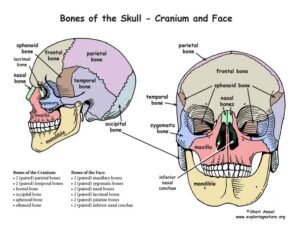
Face; The skeleton of the face is formed by 13bones in addition to the frontal bone, already described.
- 2 zygomatic or cheek bones
- 1 maxilla (originated as 2)
- 2 nasal bones
- 2 lacrimal bones
- 1 vomer
- 2 palatine bones
- 2 inferior conchae
- 1 mandible (originated as 2).
Zygomatic or cheek bones; The zygomatic bones form the prominences of the cheeks and part of the floor and lateral walls of the orbital cavities. Maxilla or upper jaw bone.This originates as two bones but fusion takes place before birth. The maxilla forms the upper jaw, the anterior part of the roof of the mouth, the lateral walls of the nasal cavity and part of the floor of the orbital cavities. The alveolar ridge, or process, projects downwards and carries the upper teeth. On each side there is a large air sinus, the maxillary sinus, lined with ciliated mucous membrane and with openings into the nasal cavity.
Nasal bones; These are two small flat bones which form the greater part of the lateral and superior surfaces of the bridge of the nose.
Lacrimal bones; These two small bones are posterior and lateral to the nasal bones and form part of the medial walls of the orbital cavities. Each is pierced by a foramen for the passage of the nasolacrimalduct which carries the tears from the medial canthus of the eye to the nasal cavity.
Vomer; The vomer is a thin flat bone which extends upwards from the middle of the hard palate to form the main part of the nasal septum. Superiorly it articulates with the perpendicular plate of the ethmoid bone.
Palatine bones; These are two L-shaped bones. The horizontal parts unite to form the posterior part of the hard palate and the perpendicular parts project upwards to form part of the lateral walls of the nasal cavity. At their upper extremities they form part of the orbital cavities.
Inferior conchae; Each concha is a scroll-shaped bone which forms part of the lateral wall of the nasal cavity and projects into it below the middle concha.
The superior and middle conchae are parts of the ethmoid bone. Mandible is the only movable bone of the skull. It originates as two parts which unite at the midline. Each half consists of two main parts: a curved body with the alveolar ridge containing the lower teeth and a ramus which projects upwards almost at right angles to the posterior end of the body. At the upper end the ramus divides into the condilar process which articulates with the temporal bone to form the temporomandibularjoint and the coronoidprocess that gives attachment to muscles and ligaments. The point where the ramus joins the body is the angle of the jaw.
Hyoid bone; this is an isolated horse–shoe–shaped bone lying in the soft tissues of the neck just above the larynx and below the mandible. It does not articulate with any other bone but is attached to the styloid process of the temporal bone by ligaments. It gives attachment to the base of the tongue.
Sinuses; Sinuses containing air are present in the sphenoid, ethmoid, maxillary and frontal bones.They all communicate with the nasal cavity and are lined with ciliated mucous membrane. Their functions are:
- To give resonance to the voice.
- To lighten the bones of the face and cranium, making it easier for the head to balance on top of the vertebral column.
At birth, ossification of the cranial sutures is incomplete. Where three or more bones meet there are distinct membranous areas, or fontanelles. The two largest are the anterior fontanelle, not fully ossified until the child is 12 to 18 months old, and the posterior fontanelle, usually ossified 2 to 3 months after birth. The skull bones do not fuse before birth to allow for moulding of the baby’s head during its passage through the birth canal.
Vertebral column; the vertebral column consists of 24 separate movable, irregular bones, the sacrum (five fused bones) and the coccyx (four fused bones).
The 24 separate bones are in three groups:
- 7 cervical,
- 12 thoracic,
- 5 lumbar.
The vertebral (neural) arch encloses a large vertebral foramen. The ring of bone consists of two pedicles that project backwards from the body and two laminae. Where the pedicles and laminae unite, transverseprocesses project laterally and where the two laminae meet in the midline posteriorly they form a spinousprocess. The neural arch has four articular surfaces: two articulate with the vertebra above and two with the one below. The vertebral foramina form the vertebral (neural) canal that contains the spinal cord.
Special features of vertebrae in different parts of the vertebral column;
Cervical vertebrae: The transverse processes have a foramen through which a vertebral artery passes upwards to the brain. The first two cervical vertebrae are atypical.
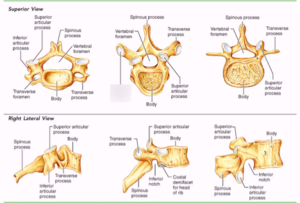
The atlas is the 1st cervical vertebra and it consists simply of a ring of bone with two short bral foramen is occupied by the odontoidprocess of the axis, which is held in position by a transverse ligament. Thus the odontoid process forms the body of the atlas. The posterior part is the true vertebral foramen and is occupied by the spinal cord. On its superior surface the bone has two articular facets which form joints with the condyles of the occipital bone of the skull. The nodding movement of the head takes place at these joints. The axis is the 2nd cervical vertebra. The body is small and has the upward projecting odontoid process that articulates with the first cervical vertebra, the atlas. The movement at this joint is turning the head from side to side.
Thoracic vertebrae; The bodies and transverse processes have facets for articulation with the ribs.
Lumbar vertebrae; These have no special features.
Sacrum; This consists of five rudimentary vertebrae fused to form a triangular or wedge-shaped bone with a concave anterior surface. The upper part, or base, articulates with the 5th lumbar vertebra. On each side it articulates with the ilium to form a sacroiliac joint, and at its inferior tip it articulates with the coccyx. The anterior edge of the base, the promontory, protrudes into the pelvic cavity. The vertebral foramina are present, and on each side of the bone there is a series of foramina for the passage of nerves.
Coccyx; This consists of the four terminal vertebrae fused to form a very small triangular bone, the broad base of which articulates with the tip of the sacrum (5 fused vertebrae).
Features of the vertebral column;
Intervertebral discs; The bodies of adjacent vertebrae are separated by inter vertebral discs, consisting of an outer rim of fibrocartilage (annulus fibrosus) and a central core of soft gelatinous material (nucleus pulposus). They are thinnest in the cervical region and become progressively thicker towards the lumbar region. The posterior longitudinal ligament in the vertebral canal helps to keep them in place. They have a shock-absorbing function and the cartilaginous joints they form contribute to the flexibility of the vertebral column as a whole.
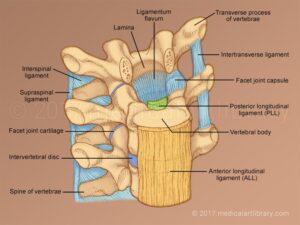
Intervertebralforamina; Throughout the length of the column there is an intervertebral foramen on each side between every pair of vertebrae, through which the spinal nerves, blood vessels and lymph vessels pass.
Ligaments; These ligaments hold the vertebrae together and help to maintain the intervertebral discs in position. The transverse ligament maintains the odontoidprocess of the axis in the correct position in relation to the atlas. The anterior longitudinal ligament extends the whole length of the column and lies in front of the vertebral bodies. The posterior longitudinal ligament lies inside the vertebral canal and extends the whole length of the vertebral column in close contact with the posterior surface of the bodies of the bones. Lower cervical vertebrae separated to show the spinal cord and spinal nerves emerging through the intervertebral foramina. The ligamenta flava connect the laminae of adjacent vertebrae. The ligamentum nuchae and the supraspinous ligament connect the spinous processes, extending from the occiput to the sacrum. When viewed from the side the vertebral column presents four curves, two Primary and two secondary. The fetus in the uterus lies curled up so that the head and the knees are more or less touching. This position shows the primary curvature. The secondary cervical curve develops when the child can hold up his head (after about 3 months) and the secondary lumbar curve develops when he stands upright (after 12 to 15 months). The thoracic and sacral primary curves are retained. Movements of the vertebral column; The movements of the column as a whole are quite extensive and include flexion (bending forward), extension (bending backward), lateral flexion (bending to the side) and rotation. There is more movement in the cervical and lumbar regions than elsewhere.
Functions of the vertebral column;
- Collectively the vertebral foramina form the vertebral canal which provides a strong bony protection for the delicate spinal cord lying within it.
- The pedicles of adjacent vertebrae form intervertebral foramina, one on each side, providing access to the spinal cord for spinal nerves, blood vessels and lymph vessels
- The numerous individual bones enable a certain amount of movement.
- It supports the skull.
- The intervertebral discs act as shock absorbers, protecting the brain.
- It forms the axis of the trunk, giving attachment to the ribs, shoulder girdle and upper limbs, and the pelvic girdle and lower limbs.
Thoracic cage; The bones of the thorax or thoracic cage are:
- 1 sternum
- 12 pairs of ribs
- 12 thoracic vertebrae.
Sternum or breast bone; This flat bone can be felt just under the skin in the middle of the front of the chest. The manubrium is the uppermost section and articulates with the clavicles at the sternodavicular joints and with the first two pairs of ribs. The body or middle portion gives attachment to the ribs. The xiphoid process is the tip of the bone. It gives attachment to the diaphragm, muscles of the anterior abdominal wall.
Ribs; There are 12 pairs of ribs which form the bony lateral walls of the thoracic cage and articulate posteriorly with the thoracic vertebrae. The first 10 pairs are attached anteriorly to the sternum by costal cartilages, some directly and some indirectly. The last two pairs (floating ribs] have no anterior attachment.
Characteristics of a rib; The head articulates posteriorly with the bodies of two adjacent thoracic vertebrae and on the tubercle there is a facet that articulates with the transverse process of one. The sternal end is attached to the sternum by a costal cartilage, i.e. a band of hyaline cartilage. The superior border is rounded and smooth while the inferior border has a marked groove occupied by the intercostal blood vessels and nerves. The first rib does not move during respiration. The spaces between the ribs are occupied by the intercostal muscles. During inspiration, when these muscles contract.
The appendicular skeleton; consists of the shoulder girdle with the upper limbs and the pelvic girdle with the lower limbs, each shoulder girdle consists of:
- 1 clavicle
- 1 scapula.
Each upper limb consists of the following bones:
- 1 humerus
- 1 radius
- 1 ulna
- 8 carpal bones
- 5 metacarpal bones
- 14 phalanges.
Clavicle or collar bone; The clavicle is a long bone which has a double curve. It articulates with the manubrium of the sternum at the sternoclavicular joint and forms the acromioclavicular joint with the acromion process of the scapula. The clavicle provides the only bony link between the upper limb and the axial skeleton.
Scapula or shoulder blade; The scapula is a flat triangular-shaped bone, lying on the posterior chest wall superficial to the ribs and separated from them by muscles. At the lateral angle there is a shallow articular surface, the glenoid cavity which, with the head of the humerus, forms the shoulder joint. On the posterior surface there is a spinous process that projects beyond the lateral angle of the bone that over hangs the shoulder joint, called the acromion process. It articulates with the clavicle at the acromiodavicular joint. The coracoid process, a projection from the upper border of the bone, gives attachment to muscles that move the shoulder joint. This is the bone of the upper arm. The head articulates with the glenoid cavity of the scapula, forming the shoulder joint. Distal to the head there are two roughened pro jections of bone, the greater and lesser tubercles, and between them there is a deep groove, the bicipital groove or intertubercular sulcus, occupied by one of the tendons of the biceps muscle. The distal end of the bone presents two surfaces that articulate with the radius and ulna to form the elbow joint.
Ulna and radius; These are the two bones of the forearm. The ulna is longer than and medial to the radius and when the arm is in the anatomical position, i.e. with the palm of the hand facing forward, the two bones are parallel. They articulate with the humerus at the elbow joint, the carpal bones at the wrist joint and with each other at the proximal and distal radioulnar joints.
Carpal or wrist bones; There are eight carpal bones arranged in two rows of four. From outside inwards they are:
- Proximal row: scaphoid, lunate, triquetral, pisiform
- Distal row: trapezium, trapezoid, capitate, hamate
These bones are closely fitted together and held in position by ligaments which allow a certain amount of movement between them. The bones of the proximal row are associated with the wrist joint and those of the distal row form joints with the metacarpal bones. Tendons of muscles lying in the forearm cross the wrist and are held close to the bones by strong fibrous bands, called retinacula.
Metacarpal bones; These five bones form the palm of the hand. They are numbered from the thumb side inwards. The proximal ends articulate with the carpal bones and the distal ends with the phalanges.The bones of the wrist, hand and fingers.The right radius and ulna with the interosseous membrane.
Phalanges or finger bones; There are 14phalanges, three in each finger and two in the thumb. They articulate with the metacarpal bones and with each other.
Pelvic girdle and lower limb; the bones of the pelvic girdle are:
- 2 innominate bones (hip bones).They are made when the ilium, ischium, and pubis join together. They are also called the os coxae. Their sacroiliac joints connect them to the spine, and the symphysis pubis is where they meet.
- 1 sacrum (5 fused vertebrae)
- 1 coccyx (4 fused vertebrae)
The bones of the each lower limb are:
- 1 femur
- 1 tibia
- 1 fibula
- 1 patella
- 7 tarsal bones
- 5 metatarsal bones
- 14 phalanges.
Innominate or hip bones; Each hip bone consists of three fused bones, the ilium, ischium and pubis. On its outer surface there is a deep depression, the acetabulum, which forms the hip joint with the almost-spherical head of femur. The ilium is the upper flattened part of the bone and it presents the iliac crest, the anterior point of which is called the anterior superior iliac spine. The pubis is the anterior part of the bone and it articulates with the pubis of the other hip bone at a cartilaginous joint, the symphysispubis; the pelvis is formed by the two innominate bones which articulate anteriorly at the symphysis pubis and posteriorly with the sacrum at the sacroiliac joints which are synovial joints. It is divided into two parts by the brim of the pelvis, consisting of the promontory of the sacrum and the iliopectineal lines of the innominate bones. The greater or false pelvis is above the brim and the lesser or true pelvis is below.
Differences between male and female pelves; The shape of the female pelvis allows for the passage of the baby during childbirth. In comparison with the male pelvis, the female pelvis has lighter bones, is more shallow and rounded and is generally roomier.
Femur or thigh bone; The femur is the longest and strongest bone of the body. The head is almost spherical and fits into the acetabulum of the hip bone to form the hip joint. In the centre of the head there is a small depression for the attachment of the ligament of the head of the femur.
The difference in shape of the male and female pelves; The neck extends outwards and slightly downwards from the head to the shaft and most of it is within the capsule of the hip joint. The posterior surface of the lower third forms a flat triangular area called the poplitealsurface. The distal extremity has two articular condyles which, with the tibia and patella, form the knee joint.
Tibia or shin bone; The tibia is the medial of the two bones of the lower leg. The proximal extremity is broad and flat and presents two condoles for articulation with the femur at the knee joint. The head of the fibula articulates with the inferior aspect of the lateral condyle, forming the proximal tibiofibular joint. The distal extremity of the tibia forms the ankle joint with the talus and the fibula.
Fibula; The fibula is the long slender lateral bone in the leg. The head or upper extremity articulates with the lateral condyle of the tibia forming the proximal tibiofibular joint and the lower extremity articulates with the tibia then projects beyond it to form the lateral malleolus.
Patella or knee cap; This is a roughly triangular–shapedsesamoid bone associated with the knee joint. Its posterior surface articulates with the patellar surface of the femur in the knee joint and its anterior surface is in the patellar tendon, i.e. the tendon of the quadriceps femoris muscle.
Tarsal or ankle bones; There are seven tarsal bones which form the posterior part of the foot. They are:
- 1 talus
- 1 calcaneus
- 1 navicular
- 3 cuneiform
- 1 cuboid.
The calcaneus forms the heel of the foot. The other bones articulate with each other and with the metatarsal bones.
Metatarsal bones of the foot; These are five bones, numbered from within outwards, which form the greater part of the dorsum of the foot. At their proximal ends they articulate with the tarsal bones and at their distal ends, with the phalanges. The enlarged distal head of the 1st metatarsal bone forms the ‘ball’ of the foot.
Phalanges of the toes;There are 14 phalanges arranged in a similar manner to those in the fingers, i.e. two in the great toe (the halux) and three in each of the other toes. The bones have a bridge-like arrangement and are supported by muscles and ligaments so that four arches are formed, a medial and lateral longitudinal arch and two transverse arches. Only the calcaneus and the distal end of the metatarsal bones should touch the ground.The bony components are the calcaneus, cuboid and the two lateral metatarsal bones.Muscles and ligaments which support the arches of the foot. Posterior tibialis muscle; this is the most important muscular support of the medial longitudinal arch.
Joint; A joint is the site at which any two or more bones articulate or come together. Some joints have no movement (fibrous), some only slight movement (cartilaginous) and some are freely movable (synovial). These immovable joints have fibrous tissue between the bones, e.g. joints between the bones of the skull (sutures) and those between the teeth and the maxilla and mandible.
Cartilaginous or slightly movable joints; There is a pad of fibrocartilage between the ends of the bones that form the joint which allows for very slight movement where the pad of cartilage is compressed. Examples include the symphysis pubis and the joints between the vertebral bodies.
A fibrous or fixed joint, e.g. the sutures of the skull.
They are classified according to the range of movement possible or to the shape of the articulating parts of the bones involved.
Ball and socket; the head or ball of one bone articulates with a socket of another and the shape of the bones allows for a wide range of movement. Those possible are flexion, extension, adduction, abduction, rotation and circumduction. Examples are the shoulder and hip joints.
Hinge joints; these allow the movements of flexion and extension only. They are the elbow, knee, ankle, the joints between the atlas and the occipital bone, and the interphalangeal joints of the fingers and toes.
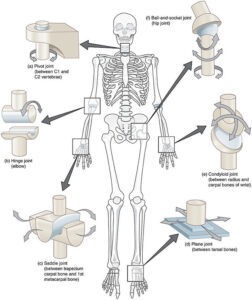
Gliding joints; The articular surfaces glide over each other, e.g. sternoclavicular joints, acromioclavicular joints and joints between the carpal bones and those between the tarsal bones.
- Pivot joints; Movement is round one axis (rotation), e.g. proximal and distal radioulnar joints and the joint between the atlas and the odontoid process of the axis.Condyloid and saddle joints. Movements take place round two axes, permitting flexion, extension, abduction, adduction and circumduction, e.g. the wrist, temporomandibular, metacarpophalangeal and metatarsopha langeal joints. Synovial joint are always covered with hyaline cartilage. It provides a smooth articular surface and is strong enough to absorb compression forces and bear the weight of the body. The cartilage lining, which is up to 7mm thick in young people, becomes thinner and less compressible with age. This leads to increasing stress on other structures in the joint. Cartilage has no blood supply and receives it’s nourishment from synovial fluid. Synovial fluid; This is a thick sticky fluid, of egg-white consistency, secreted by synovial membranes into the synovial cavity, and it:
- Provides nutrients for the structures within the joint cavity.
- contains phagocytes, which remove microbes and cellular debris
- acts as a lubricant
- maintains joint stability
- prevents the ends of the bones from being separated, as does a little water between two glass surfaces e.g. knee joint, They act as cushions to prevent friction between a bone and a ligament or tendon, or skin where a bone in a joint is near the surface.
- Ligaments that blend with the capsule provide additional stability at most joints.
- Muscles or their tendons also provide stability and stretch across the joints they move.When the muscle contracts it shortens, pulling one bone towards the other. Nerve and blood supply Nerves and blood vessels crossing a joint usually supply the capsule and the muscles that move it.
Shoulder joint; This ball and socket joint is formed by the glenoid cavity of the scapula and the head of the humerus. The glenoid cavity is deepened by a rim of fibrocartilage, the glenoidd labrum, which provides additional stability without limiting movement. The tendon of the long head of the biceps muscle, lying in the intertubercular (bicipital) groove of the humerus, extends through the joint cavity and is attached to the upper rim of the glenoid cavity.
Deltoid muscle; These muscle fibres originate from the clavicle, acromion process and spine of scapula and radiate over the shoulder joint to be inserted into the deltoid tuberosity of the humerus. It forms the fleshy and rounded contour of the shoulder. The anterior fibres cause flexion, the middle or main part, abduction and the posterior fibres extend the shoulder joint.
Pectoralis major; this lies on the anterior thoracic wall. The fibres originate from the middle third of the clavicle and from the sternum and are inserted into the lip of the intertubercular groove of the humerus. It draws the arm forward and towards the body, i.e. flexes and adducts.
Latissimus dorsi; this arises from the posterior part of the iliac crest and the spinous processes of the lumbar and lower thoracic vertebrae. It passes upwards across the back then under the arm to be inserted into the bicip ital groove of the humerus. It adducts, medially rotates and extends the arm.
Teres major; This originates from the inferior angle of the scapula and is inserted into the humerus just below the shoulder joint. It extends, adducts and medially rotates the arm.
Elbow joint; This hinge joint is formed by the trochlea and the capitulum of the humerus and the trochlear notch of the ulna and the head of the radius. Extracapsular structures consist of anterior, posterior, medial and lateral strengthening ligaments.
Biceps muscle; This lies on the anterior aspect of the upper arm. At its proximal end it is divided into two parts (heads) each of which have its own tendon. The short head rises from the coracoid process of the scapula and passes in front of the shoulder joint to the arm. The long head originates from the rim of the glenoid cavity and its tendon passes through the joint cavity and the bicipital groove of the humerus to the arm. It is retained in the bicipital groove by a transverse ligament which stretches across the groove. The distal tendon crosses the elbow joint and is inserted into the radial tuberosity. It helps to stabilise and flex the shoulder joint and at the elbow joint it assists with flexion and supination.
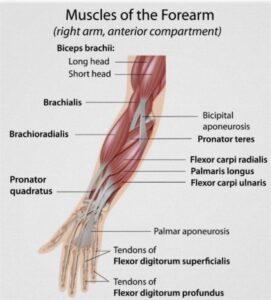
Brachialis muscle; This lies on the anterior aspect of the upper arm deep to the biceps. It originates from the shaft of the humerus, extends across the elbow joint and is inserted into the ulna just distal to the joint capsule. It is the main flexor of the elbow joint.
Triceps muscle; This lies on the posterior aspect of the humerus. It arises from three heads, one from the scapula and two from the posterior surface of the humerus. The insertion is by a common tendon to the olecranon process of the ulna. It helps to stabilise the shoulder joint, assists in adduction of the arm and extends the elbow joint. Movements Flexion: biceps and brachialis. Extension: triceps.Proximal and distal radioulnar joints. The distal radioulnar joint is a pivot joint between the distal end of the radius and the head of the ulna.
Pronator teres; This lies obliquely across the upper third of the front of the forearm. It arises from the medial epicondyle of the humerus and the coronoid process of the ulna and passes obliquely across the forearm to be inserted into the lateral surface of the shaft of the radius. It rotates the radioulnar joints, changing the hand from the anatomical to the writing position, i.e. pronation.
Supinator muscle; This lies obliquely across the posterior and lateral aspects of the forearm. Its fibres arise from the lateral epicondyle of the humerus and the upper part of the ulna and are inserted into the lateral surface of the upper third of the radius. It rotates the radioulnar joints, changing the hand from the writing to the anatomical position, i.e. supination.Movements Pronation: pronator teres. Supination: supinator and biceps.
Wrist joint; This is a condyloid joint between the distal end of the radius and the proximal ends of the scaphoid, lunate and triquetral. A disc of white fibrocartilage separates the ulna from the joint cavity and articulates with the carpal bones. It also separates the inferior radioulnar joint from the wrist joint.
Flexor carpi radialis; This lies on the anterior surface of the forearm. It originates from the medial epicondyle of the humerus and is inserted into the second and third metacarpal bones. It flexes the wrist joint, and when acting with the extensor carpi radialis, abducts the joint.
Flexorcarpi ulnaris; This lies on the medial aspect of the forearm. It originates from the medial epicondyle of the humerus and the upper parts of the ulna and is inserted into the pisiform, the hamate and the fifth metacarpal bones. It flexes the wrist, and when acting with the extensor carpi ulnaris, adducts the joint.
Extensor carpi radialis longus and brevis; These lie on the posterior aspect of the forearm. The fibres originate from the lateral epicondyle of the humerus and are inserted by a long tendon into the second and third metacarpal bones. They extend and abduct the wrist.
Extensor carpi ulnaris; This lies on the posterior surface of the forearm. It originates from the lateral epicondyle, wrist and distal radioulnar joints.
Supporting ligaments; the humerus and is inserted into the fifth metacarpal bone. It extends and adducts the wrist. Movements
- Flexion: flexor carpi radialis and the flexor carpi ulnaris.
- Extension: extensors carpi radialis (longus and brevis) and the extensor carpi ulnaris.
- Abduction: flexor and extensors carpi radialis.
- Adduction: flexor and extensor carpi ulnaris. Joints of the hands and fingers,
There are synovial joints between the carpal bones, between the carpal and metacarpal bones, between the metacarpal bones and proximal phalanges and between the phalanges. The powerful movements that occur at these joints are produced by muscles in the forearm which have tendons extending into the hand. Many of the finer movements of the fingers are produced by numerous small muscles in the hand.
The flexor retinaculum is a strong fibrous band that stretches across the front of the carpal bones, enclosing their concavity and forming the carpal tunnel. The tendons of flexor muscles of the wrist joint and the fingers and the median nerve pass through the carpal tunnel, the retinaculum holding them close to the bones. Synovial membrane forms sleeves around these tendons in the carpal tunnel and extends some way into the palm of the hand. The synovial fluid secreted prevents friction.
Hip joint; this ball and socket joint are formed by the cup-shaped acetabulum of the innominate bone and the almost spherical head of the femur. The capsular ligament includes most of the neck of the femur. There are three important ligaments that surround and strengthen the capsule. They are the iliofemoral, ischiofemoral and pubofemoralligaments;
Psoas muscle; This arises from the transverse processes and bodies of the lumbar vertebrae. It passes across the flat part of the ilium and behind the inguinal ligament to be inserted into the femur.
Quadriceps femoris; This is a group of four muscles lying on the front and sides of the thigh. They are the rectusfemoris and three vasti. The rectus femoris originates from the ilium and the three vasti from the upper end of the femur. Together they pass over the front of the knee joint to be inserted into the tibia by the patellar tendon. Only the rectus femoris flexes the hip joint. Together the group acts as a very strong extensor of the knee joint.
Gluteal muscles; These consist of theglutens maximus, medius and minimus which together form the fleshy part of the buttock. They originate from the ilium and sacrum and are inserted into the femur. They cause extension, abduction and medial rotation at the hip joint.
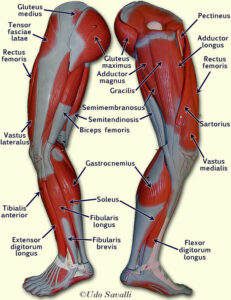
Sartorius; This is the longest muscle in the body and crosses both the hip and knee joints. It originates from the the tibia and the posterior surface of the patella. The anterior part of the capsule consists of the tendon of the quadriceps femoris muscle which also supports the patella. Synovial membrane covers the cruciate ligaments and the pads of fat. The menisci are not covered with synovial membrane because they are weight bearing. The most important strengthening ligaments are the medial and lateral ligaments. Possible movements at this joint are flexion, extension and a rotatory movement which ‘locks’ the joint when it is fully extended. When the joint is locked, balance is maintained with less muscular effort than when it is flexed.
Hamstring muscles; these lie on the posterior aspect of the thigh. They originate from the ischium and are inserted into the upper end of the tibia. They are biceps femoris, semimembranosus and semitendinosus muscles. They flex the knee joint.
Gastrocnemius; This forms the bulk of the calf of the leg. It arises by two heads, one from each condyle of the femur, and passes down behind the tibia to be inserted into the calcaneus by the calcanean tendon (Achilles tendon). It crosses both knee and ankle joints, causing flexion at the knee and plantar flexion at the ankle.
Quadriceps femoris; This extends the knee joint. Movements Flexion (bending backwards): gastrocnemius and hamstrings. Extension (straightening): quadriceps femoris muscle.
Ankle joint; This hinge joint is formed by the distal end of the tibia and its malleolus (medial malleolus) the distal end of the fibula (lateral malleolus) and the talus. There are four important ligaments strengthening this joint. They are the deltoid and anterior, posterior, medial and lateral ligaments.
Anterior tibialis muscle; This originates from the upper end of the tibia, lies on the anterior surface of the leg and is inserted into the middle cuneiform bone by a long tendon. It is associated with dorsiflexion of the foot.
Soleus; This is one of the main muscles of the calf of the leg, lying immediately deep to the gastrocnemius. It originates from the heads and upper parts of the fibula and the tibia. Its tendon joins the gastrocnemius so that they have a common insertion into the calcaneus by the calcanean (Achilles) tendon.There are a number of synovial joints between the tarsal bones, between the tarsal and metatarsal bones, between the metatarsals and proximal phalanges and between the phalanges. In addition to moving the joints of the foot these muscles support the arches of the foot and help to maintain body balance