Applied Branches of Anatomy
Gross Anatomy:
This branch of anatomy is also called macroscopic anatomy. It deals with the study of the organs, parts, and structures of the body that are visible to the naked eye.
Histology:
It is the branch of anatomy that deals with the study of the finer details of body structures with the help of a microscope.
Embryology:
It is that branch of anatomy, which deals with the study of human development before birth. Therefore, it is also referred to as developmental anatomy.
Neuroanatomy:
This branch of anatomy deals with the study of structure and organization of the nervous system of body.
Other Branches:
Regional anatomy
Systemic anatomy
Radiographic anatomy
Functional anatomy
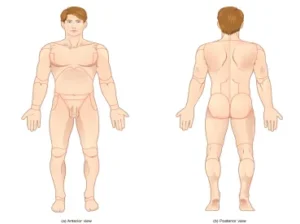
Anatomical Position:
In this position the body is regarded as standing erect, eyes looking forward to the horizon, the upper limbs hanging by the sides with the palms of the hands directed forward, and the feet are together with toes pointing forward, as shown in figure:
Anatomical planes of Body:
The principal three planes of the human body are:
Median Plane:
This is a vertical plane that divides the right side and left side of the body lengthwise along the midline into externally symmetrical sections. Any plane parallel to the median plane is called sagittal plane, paresagittal plane, or Para median plane.
Coronal Plane:
Any vertical side-to-side plane at right angles to the median plane is called coronal plane.
Transverse Plane:
If the body is divided horizontally into upper and lower sections, we get a transverse plane.
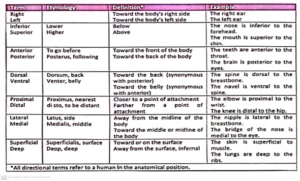
Terms of relationship in Anatomy:
Considering the human body in the anatomical position, various terms are used to describe the position or relationship of a structure. These are called terms of position or direction.