
LASIK
LASIK (laser in situ keratomileusis) is the most common type of laser eye surgery performed today. This is a two-step, two-laser vision correction procedure. A thin flap is created in the cornea to allow the reshaping to occur beneath the surface of the eye, resulting in less discomfort during healing and rapid visual recovery (when compared to advanced surface laser ablation or ASLA).
LASIK can be used to treat
- Short-sightedness (myopia)
- Longsightedness (hyperopia) and
- Astigmatism (an imperfection in the eye’s curvature that results in distorted vision).
Who Is An Ideal LASIK Candidate?
To be suitable for LASIK
General Health
Candidates must be in good physical health, and should not have specific health problems, such as uncontrolled diabetes, autoimmune or collagen vascular diseases.
Ocular Health:
LASIK patients should have no eye diseases, such as keratoconus, glaucoma, cataracts, corneal disease as well as retinal and optic nerve diseases.
Eye Problems:
Candidates should let their eye doctor know about ocular problems, like amblyopia, strabismus, or any other conditions that may affect healing. Patients should be free of eye infections or injury.
Stable Vision:
The patients’ vision must be stable for at least one year prior to the procedure date. Because hormones may affect the stability of eye prescription, pregnant or nursing women are not eligible for LASIK surgery until three menstrual cycles have passed.
Corneal Thickness:
Due to the nature of the procedure, patients must have a minimum corneal thickness of 0.5 mm.
The correction to their vision is immediate, although it may take a few weeks to completely stabilise. Before LASIK eye surgery, we perform a test called corneal pachymetry to determine the thickness of your cornea. This test involves touching a device called a pachymeter to the centre of your eye, where it uses ultrasound to measure corneal thickness.
The procedure
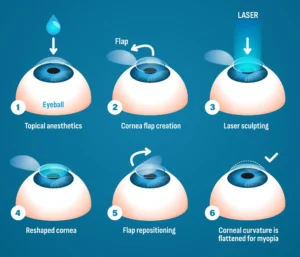
LASIK (Laser-Assisted In Situ Keratomileusis) is a quick, safe, and effective vision correction procedure. The entire surgery usually takes 10 to 20 minutes per eye, and most patients notice improved vision within 24 hours. Below are the key steps involved in the LASIK procedure.
Step 1: Eye Preparation and Numbing
Before the surgery begins, anesthetic eye drops are applied to numb the eyes. This ensures the procedure is painless, although mild pressure or a tugging sensation may be felt during certain steps.
Step 2: Stabilizing the Eye
An eyelid holder is placed to prevent blinking, and a suction ring is used to keep the eye steady. At this stage, you may experience pressure, and your vision may become dim or temporarily black—this is normal and short-lived.
Step 3: Creation of the Corneal Flap
Using a femtosecond laser (or in some cases a microkeratome), the surgeon creates a very thin flap in the cornea. The flap remains attached by a small hinge and is gently lifted to expose the underlying corneal tissue (stroma).
Step 4: Corneal Reshaping with Laser
You will be asked to focus on a light while the excimer laser reshapes the cornea. This laser precisely removes microscopic amounts of tissue to correct refractive errors such as myopia, hyperopia, or astigmatism.
An advanced eye-tracking system monitors even tiny eye movements and adjusts the laser in real time for accuracy and safety.
Step 5: Repositioning the Corneal Flap
Once the cornea has been reshaped, the surgeon carefully places the corneal flap back into its original position. The flap naturally adheres to the cornea, and no stitches are required.
Step 6: Immediate Recovery
After the procedure, you may experience mild itching, burning, or blurred vision. These symptoms usually improve within a few hours. Most patients notice significantly clearer vision by the next day, with continued improvement over the following days.
Recovery
- You can return home shortly after leaving the laser suite, but must be accompanied by a friend or family member because your vision will be slightly blurry and your sedative will not have worn off completely. You will be given protective glasses and eye drops (antibiotics and steroids) to go home with.
- Using artificial tears for at least a week after surgery is generally recommended.
- Fluctuations in your vision are normal for the first week or so following LASIK, although your vision will stabilise quickly.
- Most people find that they are now legally able to drive a car without glasses or contact lenses. However, you will need to wait a month to play contact sports and wait two weeks before swimming. If you have any questions about what activities you can or can’t participate in, please contact the clinic.