
Introduction
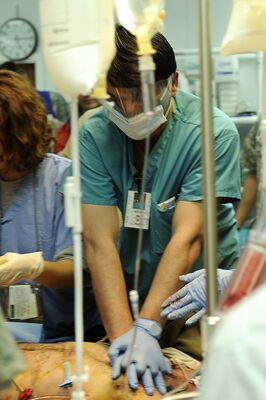 CPR
CPR
Basic Life Support (BLS) is performed to support the patient’s circulation and respiration through the use of cardiopulmonary resuscitation (CPR) until advanced life support arrives. Victims who have had early and correct BLS intervention will be better oxygenated and are more likely to respond to advanced techniques to revive them, thereby increasing their chance of survival.
BLS is the core of any resuscitation attempt, key elements include:
- Prompt recognition of cardiac arrest
- Call for urgent medical assistance
- Early effective CPR with an emphasis on minimal disruptions to compressions
- Early defibrillation
- Early advanced life support
- Integrated post-cardiac arrest care[1]
Cardiopulmonary Resuscitation (CPR)
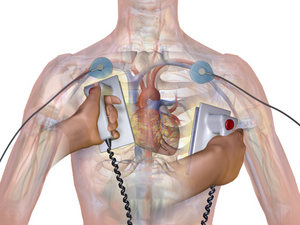 Defibrillator
CPR is a lifesaving technique. It aims to keep blood and oxygen flowing through the body when a person’s heart and breathing have stopped. Cardiac arrest occurs in unexpected places other than medical facilities.
CPR is for people experiencing cardiac arrest.
When the heart stops beating, cardiopulmonary resuscitation (CPR) is used to save the patient’s life. After a cardiac arrest, immediate CPR can double or triple the possibilities of survival.
The steps involved in CPR are known as DRSABCD (or ‘doctors ABCD’)
D – Danger R – Response S – Send for help A – Airway B – Breathing C – CPR D – Defibrillator [4]
Types of CPR
Two types of CPR exist and both have a potentially life-saving impact. They are:
- Hands-only CPR. Involves calling for help and then pushing on the chest in a rapid motion ie chest compressions. Hands-only CPR can prevent a delay in getting blood moving through the body.
- Traditional CPR with breaths. Also called CPR with breaths, this alternates chest compressions with mouth-to-mouth breaths. This type of CPR can give the body more oxygen in the critical moments before help arrives.
People who have no CPR training, received training many years ago, or are trained but not confident should use hands-only CPR.
People with training in traditional CPR, and who are comfortable with the method, can use this technique[1].
Compressions only CPR
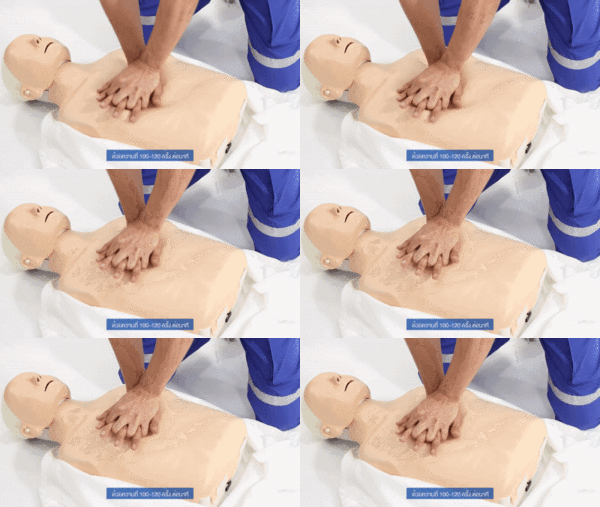 Chest Compressions
Commenced when a victim/patient is unresponsive and not breathing normally. Early compressions can improve outcomes by keeping the brain and heart perfused with the oxygenated blood in the circulatory system prior to collapse. Rules for achieving effective chest compressions:
- 100 – 120 compressions per minute (for all ages)
- Push down firmly on the sternum to 1/3 of the depth of the chest
- Push in a regular rhythm, for example counting ‘1, 2, 3’
- Compression/relaxation ratio should be 50:50 with complete recoil of chest between each compression
- Frequent rotation of personnel should be taken after approximately 200 compressions or approximately every two (2) minutes
- Avoid compression below lower limits of sternum as may cause regurgitation and/or damage to liver/spleen/stomach
- Interruptions to chest compressions should be minimised
- Avoid compressions applied too high as ineffective depth is achieved
- After each 30 compressions there is an interruption in chest compressions for two (2) rescue breaths (optional).[2]
To keep the correct rhythm of compressions it may help to use these popular songs:
- ‘Staying alive’ by the Bee Gees
- ‘Row, row, row, your boat’
- ‘Baby shark’.
Combine Rescue Breathing With Chest Compressions

CPR with breaths: Steps for adults and teens
1. Perform chest compressions.: Checking the scene for safety then place the person on a firm, flat surface, perform 30 chest compressions.
2. Open the airway: Put the palm of your hand on the person’s forehead and tilt your head back. Gently lift their chin forward with your other hand.
3. Give rescue breaths: With the airway open, pinch the nostrils shut, and cover the person’s mouth with a CPR face mask to make a seal. For infants, cover both mouth and nose with the mask. If a mask isn’t available, cover the person’s mouth with yours. Give two rescue breaths, each lasting about 1 second. Watch for their chest to rise with each breath. If it doesn’t, reposition the face mask and try again.
4. Alternate rescue breathing with chest compressions: Continue alternating 30 compressions with two rescue breaths until the person begins to breathe or until medical help arrives. If the person begins to breathe, have him or her lie on their side quietly until medical assistance is on the scene[2].
Automated External Defibrillator

An automated external defibrillator (AED) is a portable, lightweight device that delivers an electric shock to the heart when it detects an abnormal rhythm. This shock helps restore a normal heartbeat. AEDs are used during sudden cardiac arrest, which occurs when the heart unexpectedly stops beating due to a problem with its electrical system. Without quick treatment, cardiac arrest can be fatal within minutes.
When using an Automated External Defibrillator (AED), it’s important to follow these steps:
- Get the AED and open it.
- Turn on the AED.
- Prepare the person’s chest by removing clothes and drying it.
- Open the AED pads and check for pacemakers.
- Stick the AED pads on the person’s chest.
- Connect the pads to the AED if needed.
- Stop CPR, make sure no one is touching the person, and clear the area.
- Let the AED check the heart rhythm.
- If the AED says to shock, make sure no one is touching the person and press the shock button.
- Start CPR again, focusing on chest compressions for 2 minutes
- Keep following the AED’s instructions until help arrives.
Choking
Choking is a medical emergency that occurs when a foreign object becomes stuck in the throat, blocking the airway and preventing the person from breathing. This blockage cuts off the oxygen supply to the brain, and without immediate intervention, it can be fatal.
Signs and Symptoms of Choking
- Facial expressions: Panicked, confused, or surprised look.
- Hand gestures: Often, one or both hands are placed on the throat.
- Coughing: The person may cough weakly or not at all.
- Breathing sounds: High-pitched squeaks or complete silence as they attempt to breathe.
- Inability to speak: If the airway is fully blocked, the person cannot speak, cry, or cough.
- Skin color: Initially flushed (red), turning pale or bluish as oxygen is deprived.
Quick recognition of these symptoms is vital for timely action.
5 and 5 Rule for Choking
5 Back Blows:
- Position: Have the person lean forward, with their upper body parallel to the ground.
- Support: Use one hand to support their chest for stability.
- Technique: Deliver 5 firm back blows between the shoulder blades with the heel of your other hand.
5 Abdominal Thrusts (Heimlich maneuver):
- Position: Stand behind the person and wrap your arms around their waist.
- Hand Placement: Place one fist just above their navel and below the rib cage.
- Execution: Grasp your fist with your other hand and perform 5 quick, sharp upward thrusts to expel the obstruction.
- Special Cases: For pregnant or obese individuals, perform chest thrusts instead of abdominal thrusts.
Alternate between 5 back blows and 5 abdominal thrusts until:
- The blockage is cleared.
- The person becomes unconscious.
- Medical professionals arrive.
Important Note: Even if the object is expelled, have the person evaluated by a healthcare professional to rule out any potential injuries or complications.